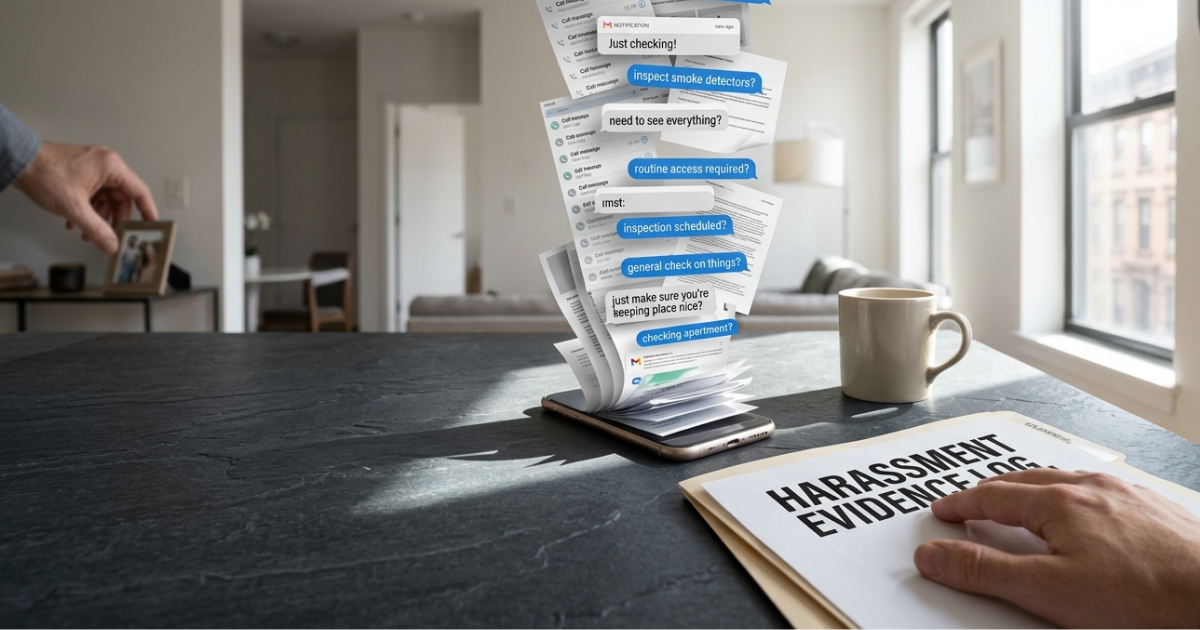
Your landlord has "inspected" your apartment four times this month. Each time, they show up with minimal or no notice, claiming they need to "check on things" or "make sure everything's okay" or "do a routine inspection." They walk through slowly, looking at your belongings, opening closets, taking photos. They stay for 10-15 minutes even though there's nothing to inspect or repair. They make comments about your lifestyle, your possessions, how you keep the apartment.
You know what this really is: intimidation. They're not inspecting anything—they're watching you, invading your privacy, making you feel uncomfortable and unsafe in your own home. The pattern is clear: since you complained about repairs (or refused a buyout, or filed an HPD complaint, or asserted some other tenant right), these "inspections" started. They want you to feel harassed. They want you anxious and desperate enough to move out.
You want to fight back. You want to report this harassment to HPD, file a court case, or at least have evidence if things escalate. But you think: "What evidence do I actually need? Will they just take my word for it, or do I need proof? What kind of proof? How do I document something that happens inside my apartment when it's just me and my landlord? What will a judge or HPD investigator actually want to see?"
Here's the truth: To prove harassment through repeated pretextual inspections, you need clear, documented evidence showing the pattern, frequency, pretextual nature, and impact. Courts and enforcement agencies don't just take your word for it—they need contemporaneous documentation, third-party corroboration where possible, and organized presentation of facts that prove harassment.
The good news: you can gather this evidence yourself, starting today, and it doesn't require expensive technology or legal expertise. Let me show you exactly what evidence you need, how to collect it properly, how to organize it, and how to use it effectively.
Why Evidence Is Critical in Harassment Cases
Before we get to what evidence to collect, understand why it matters:
Burden of Proof Is On You
When you claim harassment:
- You are making the allegation
- You must prove the pattern exists
- Burden is on you to present evidence
Landlord will deny:
- "These are legitimate inspections"
- "I have the right to check my property"
- "Tenant is exaggerating"
- "This is normal property management"
Without evidence:
- It's your word vs. landlord's word
- Judge/HPD investigator has no basis to believe you over landlord
- Case fails
With strong evidence:
- Pattern is undeniable
- Landlord's denials are contradicted by facts
- Judge/HPD can see harassment clearly
- Case succeeds
Pattern Recognition Requires Documentation
Harassment is about pattern, not single incidents:
One inspection: Could be legitimate, could be mistake
Monthly inspections for months: Pattern suggesting harassment
But to show pattern, you need records:
- Dates showing frequency
- Details showing pretextual nature
- Timeline showing escalation
- Context showing connection to your protected activity
Your memory isn't enough:
- "They inspect a lot" isn't proof
- "It started after I complained" needs dates to prove
- "It feels like harassment" needs documentation to establish
Evidence Makes Harassment Visible
Harassment often happens in private:
- Inside your apartment
- Just you and landlord
- No witnesses
- No public record
Evidence brings invisible harassment into the light:
- Documentation creates record where none existed
- Photos/video make private conduct visible
- Timeline shows pattern that wasn't obvious day-to-day
- Your log becomes testimony when you're not in the room
Core Evidence: Your Incident Log/Journal
This is your most important evidence—everything else supports this:
What Your Incident Log Should Include
For every "inspection" or unauthorized entry, record:
Date and Exact Time
Be specific:
- "March 15, 2024, 10:32am" (not "mid-March, morning")
- Use exact timestamps
- If entry happened when you weren't home, note when you discovered it: "March 15, discovered at 6:00pm when I got home from work"
Why precision matters:
- Shows frequency clearly (dates close together prove pattern)
- Can correlate with other events (filed HPD complaint March 1, inspections started March 5)
- Credibility: precise details suggest accurate record-keeping
Notice Given (or Absence of Notice)
Document notice issues:
- "No notice given"
- "Text sent at 9:15am, arrived at 10:30am (1 hour 15 minutes notice)"
- "Email sent day before at 8pm (14 hours notice, less than 24 hours required)"
- "Note left on door morning of inspection (same-day notice)"
If no notice:
- "No advance notice. Landlord appeared unannounced and unlocked door."
Why this matters:
- Lack of proper notice proves entries are improper
- Pattern of inadequate notice shows systematic violation
- Supports harassment claim (disregard for your rights)
Who Was Present
Record everyone:
- "Landlord [name] alone"
- "Landlord + superintendent + unknown man (claimed to be contractor)"
- "Superintendent only"
- "Unknown person who had key—later identified as landlord's property manager"
Why this matters:
- Identifies participants in harassment
- Shows whether "inspection" involved people who would actually inspect
- Documents if landlord sends others to harass you
Stated Reason for Entry
Record what landlord claimed:
- Quote directly if possible: "Landlord said 'just checking to make sure everything's okay'"
- Or paraphrase: "Claimed need to inspect smoke detectors"
- Note vague reasons: "'Routine inspection' with no specific purpose stated"
- Note if reason changed: "Initially said checking for leak, then said general inspection"
Why this matters:
- Vague reasons suggest pretext
- Changing reasons suggest dishonesty
- Pattern of different excuses each time shows inspections aren't legitimate
What Actually Happened During Entry
Document their actual conduct:
- "Walked through entire apartment slowly, looking in closets"
- "Took photos of my personal belongings on kitchen counter"
- "Spent 12 minutes in apartment, did not inspect or repair anything"
- "Claimed checking smoke detector but didn't touch it, just looked at it from doorway"
- "Opened my bedroom closet and looked at my clothes"
Compare stated reason to actual activity:
- Stated reason: "Check radiator"
- Actual activity: "Walked through living room, bedroom, bathroom. Looked in closets. Did not go near radiator or examine it in any way."
Why this matters:
- Discrepancy between stated reason and actual activity proves pretext
- Intrusive behavior (looking through closets, photographing belongings) proves harassment
- Lack of actual inspection/repair work proves entry wasn't legitimate
How Long They Stayed
Record duration:
- "Approximately 15 minutes"
- "8 minutes (I timed it)"
- "Less than 2 minutes—just walked through and left"
Why duration matters:
- Long duration for supposed "quick check" suggests surveillance
- Very short duration proves there was no real inspection
- Pattern of extended stays shows harassment, not legitimate inspections
What They Said/How They Acted
Record statements and demeanor:
Statements:
- "Asked intrusive questions about my work schedule"
- "Commented on my belongings: 'You have a lot of stuff'"
- "Said 'I can check my property whenever I want'"
- "Made veiled threat: 'Make sure you're keeping place nice, I'm watching'"
Demeanor:
- "Hostile and aggressive tone"
- "Deliberately intimidating—stood close, stared"
- "Looked through my things while I asked them to stop"
- "Refused to leave when I asked them to"
Why this matters:
- Statements reveal harassment intent
- Demeanor shows conduct is intimidating, not professional
- Threats are direct evidence of harassment purpose
Whether You Consented
Record your response:
- "I did not consent to entry. Told landlord they didn't give proper notice and asked them to leave. Landlord refused."
- "Asked what they were inspecting. Landlord said 'just checking.' I said this isn't necessary, please leave. Landlord ignored me and continued walking through apartment."
- "I was not home. Discovered entry when I returned—items had been moved."
Why this matters:
- Shows entry was against your will (not consensual)
- Proves you objected (contact is unwanted)
- Documents your assertion of rights (if landlord retaliates, shows protected activity)
Impact on You
Record how each incident affected you:
- "Felt violated and unsafe. Couldn't relax in my own home for rest of day."
- "Anxious and stressed. Can't predict when landlord will show up unannounced."
- "Fear of getting dressed or being home alone because landlord might walk in."
- "Can't have guests over because embarrassed landlord might intrude."
- "Sleep disrupted worrying about surprise inspections."
Why this matters:
- Harassment law looks at impact on your peace, comfort, and quiet enjoyment
- Your emotional response is evidence of harassment (intimidation is causing stress)
- Shows this isn't just "annoying"—it's materially affecting your life
Example of Complete Log Entry
INCIDENT LOG - UNAUTHORIZED ENTRY #4
Date: March 22, 2024
Time: 2:47pm entry, 3:02pm departure (15 minutes total)
Notice Given: None. Landlord appeared unannounced with no advance notice.
Who: Landlord [John Smith] alone
Stated Reason: Landlord said "routine inspection to make sure everything's up to code"
What Actually Happened:
Landlord unlocked door and entered while I was home. I asked what they were inspecting and whether they gave notice. Landlord said "I don't need notice for inspections" and walked through my apartment.
Walked slowly through living room, bedroom, bathroom, kitchen. Opened my bedroom closet door and looked inside at my clothes. Took photos on phone of my kitchen counter (my personal mail and belongings visible). Opened bathroom medicine cabinet. Did not examine any building systems, smoke detectors, appliances, or anything that would actually be "inspected." Did not make any repairs. Did not take notes. Did not find any code violations or issues.
Asked intrusive questions: "How many people live here?" (I live alone, landlord knows this). "What's your work schedule?"
Duration: Approximately 15 minutes
What I Said: "You didn't give me notice. What specifically are you inspecting?" Landlord: "This is my building, I can check my property." Me: "Please leave and give me proper notice next time." Landlord: "I'll come when I need to." Landlord stayed another 8-10 minutes after I asked them to leave.
Consent: No. I explicitly asked landlord to leave. Landlord refused and stayed another 8-10 minutes.
Context: This is the 4th unannounced "inspection" in 3 weeks. Started after I filed HPD complaint on March 1, 2024 about broken heat. Before complaint, landlord never did inspections.
Impact on Me: Felt extremely violated and intimidated. Landlord looking through my closet and photographing my personal belongings felt invasive and threatening. Anxious and on edge—can't relax in my own home. Dread coming home not knowing if landlord has been inside while I was at work. Unable to sleep well, constantly worried about next unannounced intrusion.
Witnesses: None (I was alone)
Evidence: No photos/video this time (happened too quickly and landlord was already inside before I realized). Have timestamp on phone showing exact time.
This log entry is strong evidence because:
- Precise date and time
- Documents lack of notice
- Contrasts stated reason with actual activity (claimed "inspection," actually surveillance)
- Records intrusive conduct (opening closets, taking photos)
- Documents your objection (asked them to leave, refused)
- Shows impact (feeling violated, anxious, unsafe)
- Notes context (pattern, connection to HPD complaint)
Written Communications: Preserve Everything
Save all landlord communications about inspections/access:
Texts, Emails, Letters
Save and screenshot:
Inspection notices (or lack thereof):
- Emails announcing inspections
- Texts about coming to check apartment
- Letters under door
- Screenshot each with date/time visible
Your objections:
- Your emails/texts asking for proper notice
- Your requests to limit inspections
- Your boundary-setting letters
- Save your sent messages proving you objected
Landlord's responses:
- Any hostile responses
- Statements revealing harassment intent
- Refusals to give proper notice
- Threats or intimidation
Why this matters:
- Written communications are strongest evidence (can't be disputed)
- Shows pattern over time
- Captures landlord's own words revealing harassment
- Proves you asserted boundaries and landlord ignored
Document Absence of Notice
When landlord doesn't give written notice:
In your log, explicitly state:
- "No written notice received"
- "No email, text, letter, or call announcing this inspection"
- "Landlord appeared unannounced"
Why this matters:
- Absence of notice is evidence of improper entry
- Pattern of no notice proves systematic violation
- Courts want to see you documented lack of notice
Your Boundary-Setting Letter
If you've sent letter requiring proper notice:
Save copy showing:
- Date you sent it
- What you required (24-hour written notice, legitimate purposes only, reasonable hours)
- Landlord's receipt (if sent certified mail)
Why this matters:
- Proves landlord knows proper procedures
- Shows they're deliberately violating stated boundaries
- Any inspection after this letter violates clearly stated requirements
Photos, Video, and Audio Evidence
Visual and audio evidence is powerful:
When to Record
Safe and legal situations to photograph/record:
Before entry:
- Your clock/phone showing time when landlord arrives unannounced
- Landlord at your door (if you can safely photograph through peephole or after opening door)
During entry:
- Landlord walking through apartment (if safe to record)
- Landlord opening your closets/cabinets
- Landlord photographing your belongings
- Duration of inspection (video timestamp shows how long)
After entry:
- Items that were moved (shows landlord was in apartment when you weren't home)
- Your condition (if you're shaken, upset) immediately after
Audio recording:
- In New York, you can record conversations you're part of (one-party consent state)
- Record landlord's statements during inspection
- Captures tone, threats, admissions
What to Capture
Key elements:
Timestamp:
- Date and time visible in photo/video
- Shows frequency when multiple photos show repeated entries days apart
Landlord's presence:
- Proof they were there
- Who was with them
Conduct:
- Looking through your belongings
- Taking photos
- Duration (long video shows extended intrusion)
Your objection:
- Audio: "You didn't give notice, please leave"
- Video: Showing you asking them to leave, them refusing
Example Uses
Scenario 1: Unannounced Entry
- Phone shows time: 2:15pm
- Photo of landlord at door: "Just need to check something"
- You: "Did you give me written notice?" (captured on audio)
- Landlord: "I don't need notice" (captured on audio)
- Video of landlord walking through apartment for 12 minutes
- Nothing inspected or repaired (video shows)
Evidence value: Proves unannounced entry, lack of legitimate purpose, duration
Scenario 2: Surveillance Behavior
- Video of landlord opening your closets
- Photo of landlord photographing your personal belongings
- Audio of landlord asking intrusive questions about your schedule
Evidence value: Proves conduct is surveillance/harassment, not legitimate inspection
Legal and Safety Considerations
Recording is legal in NY (one-party consent) BUT:
Safety first:
- Don't record if it escalates situation or makes you feel unsafe
- Don't let recording prevent you from getting to safety
- If landlord becomes aggressive about recording, stop and prioritize your safety
Inform or don't inform:
- You're not required to tell landlord you're recording (one-party consent)
- Sometimes telling them creates deterrent ("I'm recording this")
- Sometimes telling them escalates situation
- Use judgment based on your landlord
Quality over quantity:
- One clear video of harassment is better than 10 blurry unusable photos
- Focus on capturing key moments (arrival, intrusive conduct, your objection, departure)
Official Records and Third-Party Proof
Documentation from authorities and witnesses carries extra weight:
311 and HPD Complaints
Every time landlord does unauthorized inspection:
Call 311 in NYC:
- Report: "I want to report tenant harassment—unauthorized entry to my apartment"
- Explain: Landlord entered without notice, pretextual inspection, pattern of repeated entries
- Get complaint number
- Save number in your log
Why HPD complaints matter:
- Creates official government record
- Third-party documentation (not just your word)
- HPD may investigate
- Courts look at HPD complaint history
- Establishes you reported harassment contemporaneously
What HPD records show:
- Dates of complaints
- Pattern over time
- Your assertions about harassment
- Any HPD inspection results or violations
How to get records:
- Request your complaint history from HPD
- Print records
- Include in evidence packet
Police Reports (When Appropriate)
Call police if:
- Entry feels threatening (landlord refuses to leave, aggressive behavior)
- Late-night entry creating fear
- Landlord becomes hostile or menacing
- Any conduct that feels dangerous
What police report provides:
- Third-party official record
- Officer observations
- Date/time documentation
- Incident number
Even if no arrest:
- Report creates record
- Shows you felt threatened enough to call police
- Corroborates your harassment claim
How to use:
- Get police report number at scene
- Request copy of report
- Include in evidence
Witness Statements
People who can provide statements:
Neighbors:
- Who saw landlord entering frequently
- Who heard landlord yelling or being aggressive
- Who observed pattern of inspections
Roommates:
- Present during inspections
- Can corroborate your account
- Observed impact on you
Guests:
- Were present when landlord interrupted visit
- Saw your distress
- Witnessed intrusive conduct
What witness statement should include:
- Witness name and contact information
- Relationship to you (neighbor, roommate, friend)
- What they personally observed
- Dates/times
- Specific details
- Signed and dated
Template:
WITNESS STATEMENT
My name is [Name]. I live at [address - neighbor in same building / I am the tenant's roommate / etc.].
On [date], at approximately [time], I personally observed [describe what you saw]:
- Example: "I saw the landlord entering the tenant's apartment. I heard the tenant ask the landlord if they had given notice. The landlord said 'I don't need notice.' The tenant asked the landlord to leave. The landlord stayed inside for approximately 15 more minutes."
I have observed [pattern]:
- Example: "I have seen the landlord entering the tenant's apartment at least 6 times in the past month, often without the tenant being home."
[Any other relevant observations]
I am willing to testify about these observations if needed.
Signed: _________________
Date: ___________________
Contact: _________________
Why witness statements matter:
- Third-party corroboration
- Not just your word
- Multiple witnesses establish pattern
- Shows harassment is observable to others
How Evidence Ties Into Harassment
Understanding how evidence proves harassment:
NYC Harassment Standards
Harassment defined:
- Course of conduct
- That interferes with tenant's comfort, peace, or quiet enjoyment
- For purpose of forcing tenant to vacate or surrender rights
Your evidence must prove:
Course of conduct:
- Multiple incidents over time
- Your log shows frequency and pattern
Interference with comfort/peace/quiet:
- Impact statements in log
- Your testimony about stress and anxiety
- Witness observations of your distress
Purpose to force out or pressure:
- Context: inspections started after you asserted rights (filed HPD complaint, refused buyout, etc.)
- Timing proves retaliatory motive
- Lack of legitimate inspection purpose proves pretextual
What Legal Aid and Legal Services Emphasize
Tenant advocacy organizations consistently highlight:
Documentation is foundation:
- Detailed logs
- Saved communications
- Photos/video when possible
Official records strengthen case:
- HPD complaint numbers
- Police reports
- Building department records
Witnesses add credibility:
- Corroborate your account
- Show pattern is observable
- Not just your perception
Timeline is crucial:
- Shows escalation
- Proves pattern
- Connects harassment to your protected activity
Organizing Evidence Into Usable Packet
For court or agency, present organized evidence:
Create Master Timeline
One-page document listing all incidents chronologically:
TIMELINE OF HARASSMENT - REPEATED PRETEXTUAL INSPECTIONS
Background: I filed HPD complaint about broken heat on March 1, 2024 (HPD Complaint #123456). Inspections began 4 days later.
March 5, 2024: First inspection - no notice, landlord claimed "checking heat repair," spent 10 minutes, did not check heat
March 12, 2024: Second inspection - 2 hours notice via text, claimed "routine inspection," opened closets, took photos
March 22, 2024: Third inspection - no notice, claimed "code inspection," looked through belongings, 15 minutes
March 28, 2024: Fourth inspection - same-day notice, claimed "checking smoke detectors," didn't touch detectors
April 3, 2024: Fifth inspection - no notice while I was at work, discovered items moved
April 10, 2024: Sixth inspection - no notice, landlord refused to leave when I asked
Pattern: 6 unauthorized inspections in 5 weeks. Zero legitimate inspections in 2 years prior to HPD complaint. All inspections pretextual—no actual inspection work performed.
See attached: Detailed incident log, exhibit folder with evidence for each date
Why timeline is essential:
- Judge/investigator sees pattern at a glance
- Frequency is obvious
- Escalation is clear
- Connection to protected activity is visible
Create Organized Exhibit Folder
Label exhibits by date:
Exhibit A - March 5 Inspection:
- Log entry for March 5
- Photo showing time of entry
- Screenshot of lack of notice
Exhibit B - March 12 Inspection:
- Log entry for March 12
- Text message from landlord giving 2-hour notice
- Photos landlord took (if you have them)
Exhibit C - HPD Complaint:
- Copy of HPD complaint filed March 1
- HPD inspection report
- Violation notice
Exhibit D - My Boundary Letter:
- Letter to landlord dated March 15 requesting proper notice
- Certified mail receipt
Exhibit E - Witness Statement:
- Statement from neighbor who observed multiple entries
Why organization matters:
- Easy for judge/investigator to review
- Professional presentation
- Shows you're serious and credible
- Connects timeline to actual evidence
Prepare Summary Statement
One page explaining harassment:
SUMMARY OF HARASSMENT CLAIM
I am a tenant at [address]. My landlord has been harassing me through repeated pretextual "inspections" since I filed an HPD complaint on March 1, 2024.
Pattern: In the 5 weeks following my HPD complaint, landlord has "inspected" my apartment 6 times. In the 2 years before my complaint, landlord performed zero inspections.
Lack of Notice: 4 of 6 inspections had no advance notice. 2 had inadequate notice (2 hours and same-day).
Pretextual Nature: Landlord claims different reasons each time (heat, routine inspection, code, smoke detectors), but actual conduct is looking through my belongings, taking photos, asking intrusive questions. No actual inspection or repair work is ever performed.
Impact: I feel constantly surveilled and intimidated. I cannot relax in my own home. I am anxious about when landlord will next intrude. This is affecting my sleep, work, and wellbeing.
Retaliation: This pattern began immediately after I asserted my tenant right to file an HPD complaint about broken heat. The harassment is designed to punish me for complaining and pressure me to move.
I have documented each incident (see timeline and exhibits) and am requesting [court order stopping harassment / HPD investigation / etc.].
Why summary helps:
- Explains your case clearly
- Connects evidence to legal standards
- Shows why behavior is harassment, not legitimate
- Gives judge/investigator roadmap to your evidence
Using Your Evidence Effectively
Once you've gathered evidence:
For HPD Complaint
Present evidence when filing:
- Provide timeline
- Reference HPD complaint numbers
- Explain pattern
- Offer to provide detailed evidence
Follow up:
- If HPD investigates, provide your evidence packet
- Organized presentation helps HPD understand pattern
- May result in violations against landlord
For HP Harassment Case
Your evidence becomes your case:
- Timeline is your opening statement roadmap
- Log entries are your testimony
- Exhibits corroborate your testimony
- Witnesses testify to pattern
Lawyer uses evidence to:
- Prove course of conduct
- Establish harassment purpose
- Show impact on you
- Request court order
For Retaliation Defense
If landlord retaliates (non-renewal, eviction):
Your evidence proves retaliation:
- Timeline shows: HPD complaint → inspections started
- Pattern proves harassment was retaliation for complaint
- Your assertion of rights (filing HPD complaint) was protected activity
- Landlord's harassment = retaliation for protected activity
RPL § 223-b defense:
- Harassment evidence supports retaliation claim
- Can defend against eviction/non-renewal
- Can seek damages for retaliation
The Truth About Evidence in Harassment Cases
Here's what you need to know:
You can gather powerful evidence yourself. You don't need expensive investigators or technology. A simple log, your phone camera, and saved texts/emails are sufficient.
Start documenting now. Every day without documentation is a day of lost evidence. Begin your log today, even if harassment has been happening for months—document going forward and reconstruct what you remember from the past.
Contemporaneous documentation is most credible. Log entries made the day of incident are more believable than reconstructed timeline months later. Document as incidents happen.
Quality matters more than quantity. One detailed log entry with photo evidence is better than vague memories of "lots of inspections."
Organization is critical. Pile of random notes won't help. Organized timeline + exhibit folder makes your case clear and credible.
Official records carry extra weight. HPD complaints, police reports, witness statements add third-party corroboration.
Your log is your testimony. What you write becomes what you testify to in court. Be honest, accurate, detailed.
Evidence serves multiple purposes:
- Proof for court/HPD
- Deterrent to landlord (knowing you're documenting)
- Protection against retaliation (shows pattern if landlord takes adverse action)
- Empowerment for you (taking control through documentation)
Free legal help uses your evidence. Legal services lawyers can't create evidence for you, but they can use your evidence to build strong cases. Give them good evidence to work with.
Start now. Document everything. Organize methodically. Use evidence to stop harassment.
Find out if you have a case in 30 seconds →