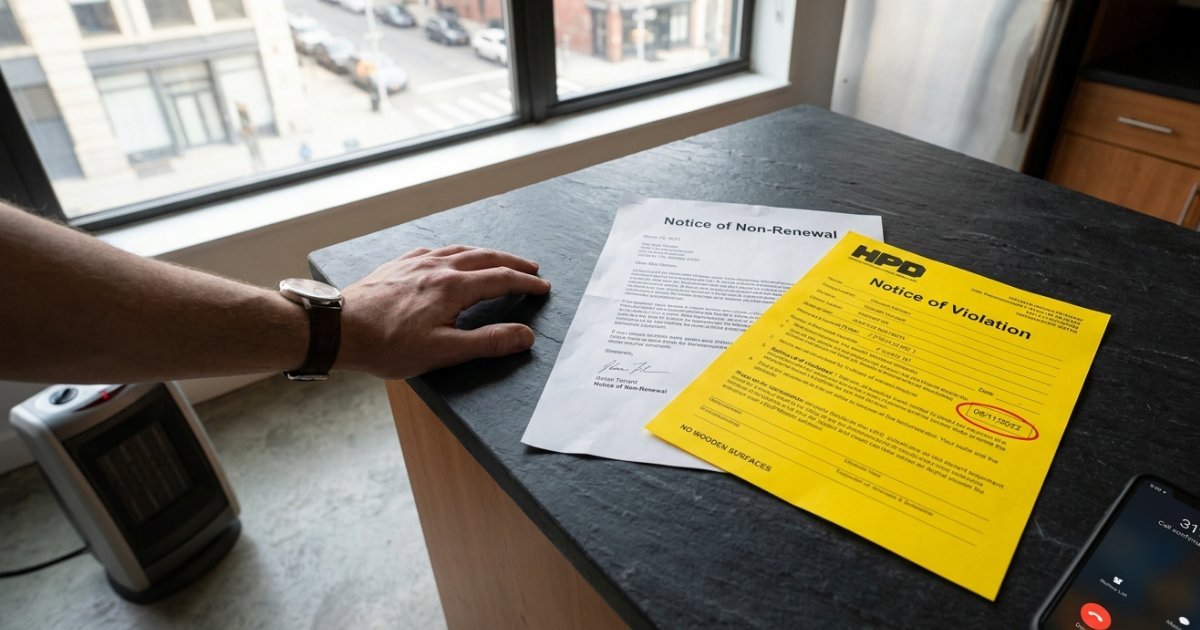
You've been living without heat for two months. Or your ceiling has been leaking for weeks, creating mold that's making you sick. Or your landlord refuses to fix broken windows, exterminate mice, or address dangerous electrical issues. You did everything you were supposed to do: you asked your landlord to fix the problems, documented the issues, and when landlord ignored you, you filed complaints with HPD or code enforcement.
The inspector came. Violations were issued. You felt a moment of relief—finally, someone with authority confirmed your apartment is uninhabitable and your landlord has to fix it.
Then, days or weeks later, an envelope arrives. It's a non-renewal notice. Your landlord is not renewing your lease. The timing is impossible to ignore—the notice came right after you complained about habitability issues, right after the inspector came, right after violations were issued. The message is clear: "You complained about conditions. Now you're out."
You panic. You think: "They're kicking me out because I reported the problems. This feels like retaliation, but what can I actually do about it? The notice says my lease isn't being renewed—doesn't that mean I have to leave? How do I prove it's retaliation? What are my options? Do I have any leverage, or am I just going to be homeless?"
Here's the truth: A non-renewal notice served right after you complain about habitability issues is a classic red flag for illegal retaliation under New York law, and you have powerful legal tools to fight back. The law specifically prohibits this, creates a presumption that it's retaliation, and gives you multiple strategic options—including staying in your apartment and forcing your landlord to prove in court that the non-renewal isn't retaliation.
A non-renewal notice doesn't automatically mean you have to leave. It's landlord's opening move, not the final word. Let me show you exactly what legal leverage you have, what you need to do right now to protect yourself, and what strategic options are available.
Why Non-Renewal After Habitability Complaints Is Illegal Retaliation
Before we get to your action plan, let's establish why what's happening to you is illegal:
The Legal Standard: RPL § 223-b
New York Real Property Law § 223-b explicitly prohibits:
Refusing to renew a tenant's lease
In retaliation for:
Making good-faith complaints to landlord or government agencies about health, safety, habitability, or code violations
What this means for your situation:
Your protected activity:
- You complained to landlord about habitability issues (broken heat, mold, leaks, mice, unsafe conditions, etc.)
- You called 311, HPD, code enforcement, or housing inspectors
- You reported violations through official channels
Landlord's retaliatory action:
- Served non-renewal notice
- Timing: shortly after your complaints/inspections/violations
Legal analysis: This is prohibited retaliation. Non-renewal following habitability complaints is exactly what the statute forbids.
Why This Pattern Is So Common
Landlords retaliate with non-renewal because:
It seems "legal" on surface:
- Landlords think: "I can choose not to renew for any reason or no reason"
- They believe non-renewal is untouchable discretion
- They assume timing won't matter
It achieves their goal (getting rid of complaining tenant):
- Tenant who reports violations leaves
- Apartment becomes available to re-rent at higher price
- Violations become next tenant's problem (or landlord fixes them after you're gone)
It discourages other tenants from complaining:
- Other tenants see what happened to you
- They learn: "Complain about conditions = lose your home"
- Future violations go unreported
What landlords don't understand:
- Retaliation law specifically covers non-renewal
- Timing creates legal presumption of retaliation
- Burden shifts to landlord to prove non-retaliation
- Courts see through this tactic constantly
The One-Year Retaliation Presumption (Your Main Weapon)
This is your most powerful legal protection:
If landlord serves non-renewal notice or files holdover eviction within approximately one year after your good-faith complaint about habitability issues:
The law creates a rebuttable presumption that the non-renewal is retaliatory.
What "rebuttable presumption" means:
Presumption: Court automatically assumes non-renewal is retaliation based on timing alone
Rebuttable: Landlord can attempt to disprove presumption by presenting evidence of legitimate, non-retaliatory grounds
Burden on landlord: Landlord must prove they're NOT retaliating—you don't have to prove they ARE
If landlord can't meet burden: Non-renewal is deemed retaliatory and blocked
What this means practically:
Your timeline:
- March 1: You call 311 about broken heat and mold
- March 10: HPD inspects, finds violations
- March 15: Violations issued to landlord
- April 5: Non-renewal notice arrives
Legal effect:
- Non-renewal is within one year of complaint (well within presumption window)
- Presumption automatically applies
- In court, landlord must prove legitimate reason for non-renewal
- If landlord can't prove legitimate non-retaliatory reason, you win
This presumption is your leverage. It transforms non-renewal from "landlord's discretion" into "landlord's burden to justify."
What You Must Do RIGHT NOW
If you've received a non-renewal notice after complaining about habitability issues, immediate action is critical:
Action 1: Preserve a Clean, Detailed Paper Trail
Your evidence is everything. Start documenting NOW:
Document Your Habitability Complaints
Gather proof that you complained about conditions:
Complaints to landlord:
- Emails requesting repairs
- Texts about broken heat, leaks, mold, mice, etc.
- Letters (certified mail receipts if you sent any)
- Voicemails or notes about phone calls
- Dates of each complaint
- Landlord's responses (or lack of response)
Complaints to government agencies:
- 311 call confirmation numbers
- HPD complaint numbers
- Code enforcement complaint records
- Dates you filed each complaint
- Save confirmation emails
Inspection records:
- Dates inspectors came
- Inspection reports (request copies if you don't have them)
- Violation notices issued to landlord
- Photos inspectors took (request if possible)
- Any correspondence from HPD/code enforcement
Your own documentation of conditions:
- Photos showing broken heat, mold, leaks, structural issues, pest infestation
- Videos documenting problems
- Timestamps on all photos/videos
- Thermometer readings (if heat issues)
- Medical records (if conditions affected your health)
Why this matters: Proves you engaged in protected activity (habitability complaints). Establishes that your complaints were good-faith and about real conditions, not frivolous.
Create Comprehensive Timeline
Make detailed chronological document showing the pattern:
Format:
[Date]: [Event]
Example Timeline:
December 2023: Heat stopped working
December 15, 2023: Emailed landlord requesting heat repair
December 20, 2023: Landlord responded "will look into it"
January 5, 2024: Heat still broken, called landlord, no response
January 15, 2024: Called 311 to report no heat, complaint #123456789
January 20, 2024: HPD inspector came to apartment
January 25, 2024: HPD issued heat violations to landlord
February 1, 2024: Received non-renewal notice in mail
Key dates to include:
- When problems started
- When you first complained to landlord
- Each subsequent complaint
- When you called 311/HPD/code enforcement
- Inspection dates
- When violations were issued
- When non-renewal notice was received
Calculate time between complaint and non-renewal:
- "Non-renewal notice received 11 days after HPD violations issued"
- "Non-renewal notice received 17 days after 311 complaint filed"
Why this timeline is crucial:
- Visually demonstrates the retaliation pattern: complaint → violations → non-renewal
- Proves timing that triggers presumption
- Will be primary evidence in court
- Helps lawyer immediately assess strength of case
Document the Non-Renewal Notice Itself
Save everything related to non-renewal:
The notice:
- Original notice (don't lose it)
- Make multiple copies
- Photograph it
- Note exact date you received it
- Note method of delivery (mail, hand-delivered, posted on door)
Any reasons given:
- Did notice state reason for non-renewal?
- If yes, what reason? (Save exact wording)
- If no reason given, note that
Any communications about non-renewal:
- Texts, emails, conversations with landlord
- Particularly: any statements connecting non-renewal to your complaints
- Example: "You shouldn't have called the city" or "If you didn't want to renew, you shouldn't have made trouble"
Why this matters: The notice and landlord's statements (or lack of explanation) are evidence. Timing of notice relative to complaints proves retaliation.
Document Communications That Reveal Motive
Save any landlord statements showing retaliatory intent:
Direct evidence (rare but powerful):
- "This is what happens when you call inspectors"
- "You reported me, so I'm not renewing"
- "You made your choice when you complained"
Indirect evidence:
- Hostile communications after your complaints
- Changed attitude/treatment after inspections
- Sudden enforcement of rules never enforced before
- Threats or intimidation
Document verbal statements:
- If landlord says something retaliatory verbally, write it down immediately
- Record: date, time, exact words (as best you remember), witnesses present
- Email yourself contemporaneous record
Action 2: Get Legal Help IMMEDIATELY (Before Lease Ends)
CRITICAL: Don't wait until lease expires or landlord files eviction. Get lawyer NOW.
Why immediate legal help is essential:
Strategic planning:
- Lawyer helps you decide whether to stay past lease end
- Assesses strength of your retaliation case
- Advises on best approach (defend holdover vs. affirmative action)
- Prepares defense before landlord files court case
Time to gather evidence:
- Lawyer can request documents from HPD, code enforcement
- Subpoena landlord's records if necessary
- Organize your evidence into compelling case
- Prepare witnesses
Leverage in negotiations:
- Lawyer can contact landlord citing retaliation law
- May negotiate resolution (repairs + lease renewal, or favorable move-out terms)
- Landlord may back down when facing lawyer who knows retaliation law
Avoid missing deadlines:
- If landlord files eviction, you have limited time to respond
- Having lawyer already on board means immediate response
- Don't get caught scrambling for representation at last minute
Where to Get Free Legal Help
NYC:
Call 311 and ask for Tenant Helpline:
- Will connect you to free legal services
- Explain: "I received non-renewal notice right after reporting habitability violations. I believe it's retaliation."
Legal services organizations:
- Legal Services NYC: 917-661-4500
- Legal Aid Society: 212-577-3300
- Housing Court Answers: 212-962-4795
- Metropolitan Council on Housing: 212-979-0611
Right to Counsel:
- If landlord files eviction (holdover), you have right to free lawyer if income-eligible
- But get help NOW before eviction is filed
Outside NYC:
Use LawHelpNY.org:
- Find legal services in your county
- Search by location and "housing" or "eviction"
Local bar associations:
- Many have pro bono or reduced-fee referral programs
- Specifically ask for tenant lawyers experienced with retaliation
Law school clinics:
- Columbia, NYU, CUNY, Brooklyn Law School, and others have tenant clinics
- Provide free representation
What to Tell Legal Services Intake
Be specific about retaliation:
"I need help with illegal retaliation under RPL § 223-b. I complained to HPD about habitability issues [or: called 311, reported code violations] on [date]. Violations were issued on [date]. I received a non-renewal notice on [date], [X] days after my complaint. I believe this is retaliation for reporting unsafe conditions. I need advice on defending against retaliatory non-renewal."
Mention if you have any of these:
- Rent stabilization or rent control status
- Good Cause Eviction Law coverage
- Disability requiring reasonable accommodations
- Section 8 voucher
- Any other protections
These additional factors strengthen your case and expand your legal options.
Action 3: Decide Strategic Approach (With Lawyer's Guidance)
You have multiple strategic options. Your lawyer will help you choose:
Option 1: Stay Past Lease End and Defend Holdover
How this works:
You don't move out when lease expires:
- Continue living in apartment
- Continue paying rent at current rate
- Become month-to-month tenant (or holdover, depending on jurisdiction)
Landlord must file holdover eviction to remove you:
- Landlord can't forcibly remove you without court order
- Must go to Housing Court
- Must prove grounds for eviction
You raise retaliation defense in eviction case:
- File Answer citing RPL § 223-b
- Assert one-year presumption
- Present timeline and evidence
- Burden shifts to landlord to prove non-retaliation
Possible outcomes:
Best case: Court finds non-renewal retaliatory, blocks eviction, you stay (lease may be deemed renewed)
Good case: Court finds retaliation, gives you significant time to find new apartment, landlord must complete repairs, possible settlement with moving expenses
Worst case: Court finds landlord overcame presumption (rare with strong timing evidence), eviction proceeds but you had months of extra time
Pros:
- Forces landlord to prove case in court
- Presumption works in your favor
- Right to Counsel provides free lawyer
- Buys significant time even if you ultimately lose
- May result in staying permanently if retaliation proven
- Landlord faces costs and uncertainty
Cons:
- Eviction case on your record (even if dismissed)
- Stress of court proceedings
- Risk of losing and owing legal fees (though rare in retaliation cases)
- Potential difficulty renting elsewhere with pending eviction case
Best for: Strong retaliation cases with clear timing, when you want to stay in apartment or maximize leverage
Option 2: Negotiate Settlement Before Moving
How this works:
Lawyer contacts landlord:
- Cites retaliation law and presumption
- Points out landlord's legal risk if they proceed
- Proposes negotiated resolution
Possible settlements:
- Landlord withdraws non-renewal, renews lease (possibly with completion of repairs)
- Landlord pays moving expenses + deposit for new apartment
- Extended move-out timeline (3-6 months instead of 30 days)
- No eviction filing, clean rental history
Pros:
- Avoids court
- Faster resolution
- No eviction on record
- May get financial assistance or repairs
Cons:
- You're agreeing to move (if that's settlement)
- No precedent or court determination
- Landlord may refuse to negotiate
Best for: When you'd prefer to move with time and assistance rather than fight in court
Option 3: File Affirmative Legal Action
How this works:
You proactively file lawsuit before eviction:
- Supreme Court action for injunction
- HP proceeding in Housing Court (NYC)
- Seek court order blocking retaliatory non-renewal
- Seek damages for retaliation
Pros:
- You control timing and framing
- Offensive rather than defensive posture
- Can seek damages beyond just blocking eviction
- Strong statement of rights
Cons:
- More complex than eviction defense
- May not qualify for free legal services (not eviction defense)
- Requires upfront legal action
Best for: Very strong cases where you want to take legal offensive, or when combined with other landlord violations
Option 4: Move Out Under Protest While Preserving Legal Claims
How this works:
You move out by lease end but:
- Document that you're moving under protest due to retaliation
- Reserve legal claims
- Potentially file lawsuit for damages after moving
Possible claims:
- Damages for retaliatory eviction/constructive eviction
- Moving expenses
- Difference in rent if forced to pay more elsewhere
- Emotional distress
Pros:
- Avoid eviction case
- Find new housing quickly
- Can still pursue legal claims
Cons:
- You've moved (goal of retaliation achieved)
- Harder to prove damages after fact
- May not find lawyer to take post-move case
Best for: When you absolutely need to move for other reasons but want to preserve some legal recourse
Your lawyer will evaluate:
- Strength of your retaliation evidence
- Your financial situation and risk tolerance
- Local Housing Court patterns
- Whether you want to stay or would prefer to move with assistance
- Other protections you may have (rent stabilization, Good Cause, etc.)
Action 4: Take Additional Strategic Steps Now
While working with lawyer, take these actions:
Request Written Reason for Non-Renewal
Send formal request to landlord:
Template:
"[Date]
Dear [Landlord],
I received your notice of non-renewal dated [date]. Please provide a written explanation of the reason(s) for your decision not to renew my lease.
New York law requires landlords to provide good cause for non-renewal in certain circumstances, and I am evaluating my legal rights.
Please respond in writing within [7-10] days.
Thank you, [Your name]"
Why this matters:
If landlord provides reason:
- You have their stated justification in writing
- Can evaluate whether reason is pretextual
- Can challenge false reasons with evidence
- Locks landlord into explanation (can't change story later)
If landlord refuses to provide reason or gives vague response:
- Suggests they don't have legitimate reason
- Silence or evasiveness is evidence of retaliation
- "No reason given" helps prove pretext
If landlord admits retaliation (rare):
- Direct evidence proving your case
Check Your Tenant Status and Protections
Determine if you have additional protections:
Rent stabilization or rent control:
- Non-renewal heavily restricted
- Landlord must prove specific grounds for non-renewal
- Retaliation is NOT valid ground
- Contact DHCR (Division of Housing and Community Renewal)
Good Cause Eviction Law coverage:
- Check if your apartment is covered
- Good Cause requires landlord to prove good cause for non-renewal
- Retaliation is NOT good cause
- Provides independent basis to challenge non-renewal
Section 8 voucher:
- HUD regulations protect against retaliation
- Can file complaint with HUD
- Additional legal protections
Disability:
- If you requested reasonable accommodation for disability
- Refusing to renew after accommodation request may violate Fair Housing Act
- Separate legal claim
If you have any of these protections:
- Non-renewal may be illegal for multiple independent reasons
- Strengthens your legal position significantly
- Tell your lawyer immediately
Continue Pressing for Repairs Through Official Channels
Don't stop asserting your rights:
Keep reporting unrepaired violations:
- If landlord hasn't fixed conditions, keep calling 311/HPD
- Request re-inspections
- Document ongoing habitability issues
Why this matters:
Shows good faith:
- Your complaints were about real conditions, not harassment
- You're continuing to seek repairs because problems are ongoing
- Undermines any claim that your original complaints were frivolous
Creates more evidence:
- Additional inspections and violations strengthen retaliation case
- Ongoing record shows landlord is neglecting duties
- May support constructive eviction or habitability claims
Increases landlord's liability:
- More violations = more legal exposure
- Creates pressure to negotiate
- Makes retaliation more obvious (refusing to renew tenant who keeps reporting violations landlord won't fix)
Document Any Continued Retaliation
If landlord escalates retaliation after non-renewal notice:
Watch for:
- Harassment (excessive contact, surprise visits, intimidation)
- Service interruptions (cutting heat, hot water, electricity)
- Refusing to make emergency repairs
- Threatening behavior
- Creating additional false violations
Document everything:
- Each incident with date, time, description, witnesses
- Photos, videos, communications
- Pattern showing escalation
Why this matters:
- Additional retaliation strengthens your case
- Shows ongoing pattern
- May support harassment claim in addition to retaliation
- Demonstrates landlord's retaliatory motive
What Happens If You Stay and Landlord Files Holdover Eviction
If you choose to stay past lease end (strategic option recommended by many tenant lawyers), here's what happens:
Timeline of Holdover Eviction
Step 1: Lease expires
- You continue living in apartment
- You continue paying rent
- You become month-to-month or holdover tenant
Step 2: Landlord serves termination notice
- 30-day notice for month-to-month tenancies (typical)
- Notice states landlord is terminating tenancy
- You still don't have to move—this is just procedural notice
Step 3: Landlord files holdover petition in Housing Court
- Landlord pays filing fee
- Petition states grounds: lease expired, proper notice given
- Court sends you petition and hearing date
Step 4: You file Answer raising retaliation defense
- You have ~10 days to file Answer (check your petition for exact deadline)
- Answer denies landlord's claims
- Answer asserts affirmative defense of retaliation under RPL § 223-b
- Answer cites timeline: complaint → violations → non-renewal
Step 5: Court proceedings
- Initial court appearance
- Discovery (exchange of documents)
- Possible mediation
- Trial if no settlement
Step 6: Court decision
- If court finds retaliation: eviction dismissed, you stay
- If landlord overcomes presumption: eviction granted, but often with extended time
How You Defend Against Holdover
Your Answer will include:
Affirmative defense of retaliation:
"Tenant engaged in protected activity by making good-faith complaints to HPD about serious habitability violations on [date]. HPD inspected on [date] and issued violations on [date]. Landlord served non-renewal notice on [date], [X] days after tenant's protected complaint. Under RPL § 223-b, this non-renewal is presumed retaliatory. Landlord cannot prove legitimate, non-retaliatory grounds for non-renewal. This eviction must be dismissed as retaliatory."
Evidence you'll present:
- Timeline document
- HPD complaint records and violations
- Photos of conditions
- Communications showing landlord's retaliation
- Witness testimony if relevant
Burden on landlord:
- Landlord must prove legitimate reason for non-renewal
- "Lease expired" isn't enough when retaliation presumption applies
- Landlord must show decision would have been made regardless of complaint
Landlord's likely arguments and your responses:
Landlord: "Lease expired, I have right not to renew" Your response: "Not when non-renewal is retaliation for protected activity. Timing proves retaliation."
Landlord: "I want apartment for family member" Your response: "Where's evidence of family member's plan to occupy? This claim is pretextual—no documentation, sudden decision right after complaint."
Landlord: "Tenant violated lease" Your response: "What violations? When were they raised before non-renewal? Why weren't they addressed during tenancy? Sudden discovery of 'violations' after complaint proves pretext."
Landlord: "Market rent increase" Your response: "Irrelevant. Can't use market conditions to disguise retaliation. Timing proves true motive."
Possible Outcomes
Outcome 1: Complete Victory
- Court finds non-renewal clearly retaliatory
- Landlord failed to overcome presumption
- Eviction dismissed
- Lease deemed renewed or tenancy continues
- You stay in apartment
- Landlord may be ordered to complete repairs
- Landlord may pay your attorney fees
Outcome 2: Partial Victory
- Court finds strong evidence of retaliation
- Grants you extended stay (6-12 months)
- Orders landlord to complete repairs during extension
- Gives you time to find new apartment
- No eviction judgment on record (stipulation to vacate by date instead)
- Landlord may pay moving expenses as settlement
Outcome 3: Landlord Settles
- During court process, landlord realizes retaliation case is strong
- Offers settlement: withdraw eviction, renew lease, complete repairs
- OR: Extended move-out time + moving expenses + no judgment
- You avoid trial, get favorable terms
Outcome 4: Landlord Overcomes Presumption (Rare)
- Landlord presents very strong evidence of legitimate non-retaliatory grounds
- Court finds timing was coincidence
- Eviction granted
- BUT you still got months of additional time
- AND you forced landlord to prove case (not automatic)
Statistics favor tenants in strong retaliation cases. Timing evidence is very powerful.
Special Considerations for Different Tenant Protections
Your situation may have additional legal dimensions:
If You're Rent Stabilized
Rent stabilization provides independent protection:
Non-renewal restrictions:
- Landlord can only refuse renewal for specific enumerated grounds
- Must provide proper notice and reasons
- Retaliation is NOT valid ground
Your defenses:
- Retaliation (RPL § 223-b)
- PLUS rent stabilization protections
- PLUS potential claim to DHCR
Action steps:
- File complaint with DHCR
- Cite both retaliation and rent stabilization violations
- You may have right to automatic renewal regardless of retaliation
Outcome: Very strong case. Rent stabilization + retaliation = nearly impossible for landlord to justify non-renewal.
If You're Covered by Good Cause Eviction Law
Good Cause requires landlord to prove good cause:
Valid grounds under Good Cause:
- Nonpayment (after opportunity to cure)
- Nuisance (substantial, after cure opportunity)
- Illegal use
- Owner/family occupancy (with strict requirements)
- Substantial rehabilitation (with strict requirements)
Your situation:
- Landlord refusing to renew after habitability complaint
- This is NOT good cause
- Independent violation of Good Cause law
Your defenses:
- Retaliation (RPL § 223-b)
- PLUS Good Cause violation (no good cause for non-renewal)
- Two independent legal violations
Outcome: Extremely strong case. Good Cause + retaliation = landlord has no valid legal basis for non-renewal.
If You Have Section 8 Voucher
HUD regulations prohibit retaliation:
Protected activities under HUD:
- Reporting housing quality issues
- Requesting inspections
- Asserting tenant rights
Retaliation prohibited:
- Refusing to renew because tenant reported violations
- Non-renewal in retaliation for Section 8 inspection failures
Your options:
- File complaint with HUD
- Raise retaliation in Housing Court
- Federal fair housing protections apply
Outcome: Federal protections add another layer. Landlord faces HUD penalties plus state retaliation consequences.
The Truth About Non-Renewal After Habitability Complaints
Here's what you need to know:
Non-renewal after habitability complaints is classic retaliation. Courts see this pattern constantly. Judges know landlords use non-renewal to punish tenants who report violations.
The one-year presumption is extremely powerful. It shifts entire burden to landlord. Timing alone creates presumption—you don't have to prove landlord's subjective intent.
Landlords rarely overcome the presumption when timing is close (days or weeks between complaint and non-renewal).
Non-renewal notice doesn't mean you must leave. It's landlord's demand, not a court order. You can stay and force landlord to go to court.
Staying past lease end is often the strongest strategic move because it forces landlord to prove case and invokes presumption.
Free legal representation is available. Right to Counsel (NYC eviction cases) and legal services organizations throughout state.
Fighting back has multiple benefits even if you ultimately move:
- Buys significant time (months to year)
- May result in financial settlement
- Forces repairs
- Holds landlord accountable
- Protects other tenants
If you don't fight:
- Landlord's retaliation succeeds
- You lose home for exercising legal rights
- Other tenants learn not to report violations
- Unsafe conditions continue
- Illegal tactic is validated
The law exists specifically to prevent this outcome. Retaliation law protects your right to safe housing and your right to report violations without losing your home.
Use the law. Document everything. Get lawyer. Stay and defend. Make landlord prove their case.
Your right to habitable housing and your right to report violations are both legally protected.
The non-renewal is illegal retaliation. Fight it.
Find out if you have a case in 30 seconds →