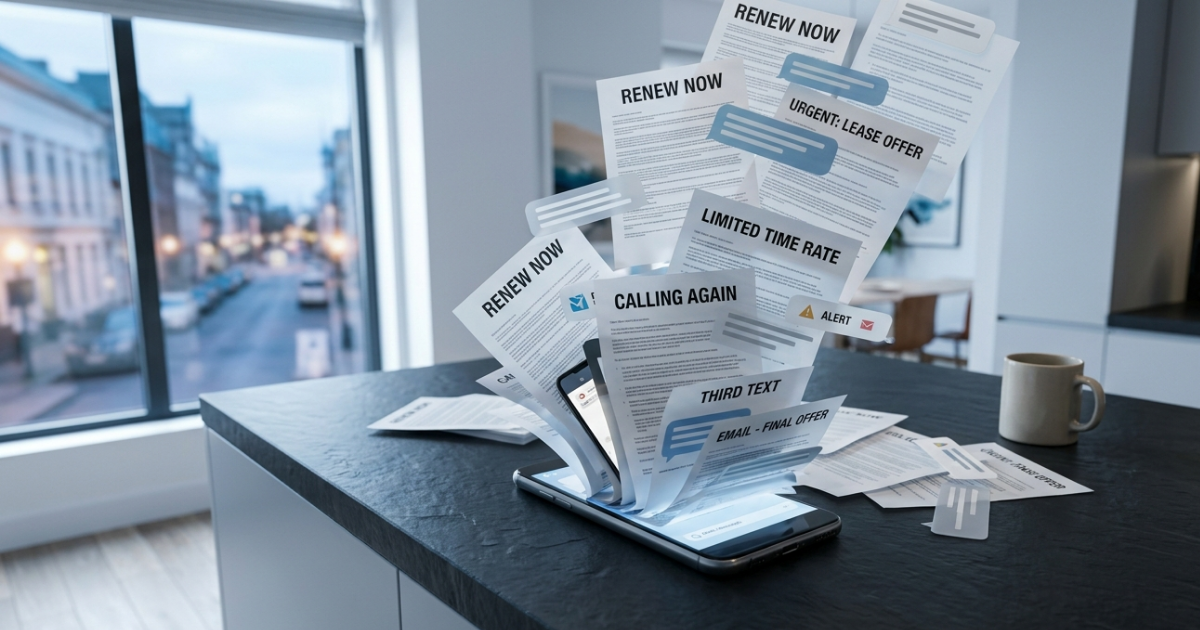
You're seven months into a one-year lease. You're settled, your rent is paid on time, you've been a model tenant. Then it starts: your landlord calls asking if you want to renew. You say, "My lease doesn't end for five more months—I haven't thought about it yet." Landlord says okay.
Two days later, another call. "Just following up on renewal. I need to know soon." You say again, "I'm not ready to decide. I'll let you know when I'm closer to the end of my lease."
A week later, an email: "Renewal offer attached. Need answer by end of week." You don't respond.
Three days later, another call. Then a text. Then another email. "This is a great rate, but it expires soon if you don't commit now." More calls. More texts. More emails. Your landlord is contacting you multiple times per week—sometimes multiple times per day—about signing a renewal when your current lease doesn't expire for months.
You're starting to dread your phone ringing. You're anxious about checking email. You've told them you're not ready to discuss renewal, but they won't stop. The pressure feels relentless. You think: "Can they do this? I'm in the middle of my lease—why are they pressuring me to commit now? Is this harassment? Or is this just normal landlord business that I have to tolerate?"
Here's the truth: Persistent, aggressive pressure to sign a renewal months before your lease ends can absolutely constitute harassment, especially when you've clearly asked landlord to stop contacting you and they ignore your boundaries. While initial early contact about renewal might be annoying but not illegal, the pattern you're describing—repeated, unwanted contact after you've said you're not ready, escalating frequency and pressure—crosses the line into harassment.
Let me show you exactly where the line is between "normal early renewal discussion" and "illegal harassment," what makes renewal pressure harassing versus routine, and what you can do to stop it.
Why Landlords Pressure Early Renewals
Before we establish the legal boundaries, let's understand why landlords use this tactic:
Landlord's Business Motivation
Landlords want early commitments because:
Certainty and planning:
- Know whether apartment will be vacant
- Plan for turnover or continued occupancy
- Avoid last-minute scramble if tenant doesn't renew
Lock in current tenant at favorable terms:
- Secure renewal before tenant starts apartment hunting
- Prevent tenant from leveraging other options in negotiations
- Avoid vacancy costs if tenant leaves
Pressure tactics work:
- Tenants feel obligated to respond to repeated contact
- Persistent pressure wears tenants down into quick decisions
- Early commitment prevents tenant from negotiating later
Control the timeline:
- Landlord sets renewal terms months early
- Tenant doesn't have time to evaluate market, consider options
- "Limited time offer" creates false urgency
Why Early Renewal Pressure Feels Wrong
You instinctively resist because:
You're still in middle of current lease:
- You have months remaining on existing lease
- You've paid for this occupancy period
- Feels wrong to be pressured about next lease when current one isn't close to ending
You haven't had time to evaluate:
- Don't know yet if you want to stay
- Haven't looked at other apartment options
- Haven't decided on future plans
- Being forced to decide before you're ready
The pressure is relentless:
- Repeated contact feels harassing
- Can't escape landlord's demands
- Anxiety about checking phone/email
- Feels coercive rather than informative
Your instinct is correct. There's a difference between legitimate early renewal discussion and harassing pressure campaign.
What's "Normal" Renewal Timing vs. Concerning Early Pressure
Let's establish what's standard versus what's problematic:
Normal Renewal Timelines
Market-rate (unregulated) apartments:
Industry standard:
- Renewal discussions typically begin 90-120 days (3-4 months) before lease expiration
- This gives both parties time to plan
- Reasonable window for tenant to evaluate options
- Allows landlord to market apartment if tenant declines
Acceptable early contact:
- Single email 4-5 months before expiration: "I wanted to touch base early about renewal. When you're ready to discuss, let me know."
- This is informational, not pressure
- Respects tenant's timeline
- One communication, not repeated harassment
What's NOT normal for market-rate:
- Contacting tenant 6+ months before expiration repeatedly
- Demanding answer "immediately" when lease has months remaining
- Repeated contact after tenant says they're not ready
- Pressure tactics creating false urgency
Rent-Stabilized Apartments (Specific Legal Requirements)
For rent-stabilized tenancies:
Legal requirement (NYC Rent Stabilization Code):
- Landlord MUST offer renewal 150-90 days before lease expiration
- Not earlier (landlord cannot demand earlier commitment)
- Not later (tenant has right to timely renewal offer)
What this means:
- Landlord contacting rent-stabilized tenant 6-7 months early is violating regulations
- Proper window: 5-3 months before expiration
- Tenant has 60 days to accept renewal offer
If you're rent-stabilized and landlord is pressuring early:
- This violates Rent Stabilization Code timing requirements
- Contact DHCR (Division of Housing and Community Renewal)
- File complaint for improper renewal timing
When Early Contact Becomes Problematic
Even for market-rate apartments, early renewal pressure becomes concerning when:
Red Flag 1: Timing Is Unreasonably Early
Concerning timelines:
- 6+ months before lease expiration
- More than halfway through current lease
- "As soon as you moved in" (landlord asking about renewal in first months of tenancy)
Why this is problematic:
- Tenant hasn't had time to evaluate living situation
- Can't reasonably assess whether to renew
- Creates pressure to commit prematurely
- Suggests landlord is trying to lock tenant in before they have options
Example:
- You sign 1-year lease starting January 1
- In March (2 months into lease), landlord starts pressuring renewal
- You have 10 months remaining on current lease
- This is unreasonably early and suggests pressure tactic
Red Flag 2: Frequency Is Excessive
One or two contacts = annoying but probably not harassment
Harassment pattern:
- Multiple contacts per week
- Daily calls, texts, or emails
- Contact across multiple channels (call + text + email on same day)
- Escalating frequency after you don't respond
Example of harassment pattern:
- Week 1: Two calls, one email
- You respond: "Not ready to discuss renewal yet"
- Week 2: Three calls, two texts, one email
- You don't respond (hoping they'll stop)
- Week 3: Five calls, four texts, two emails
- Pattern: Escalating frequency despite your stated lack of readiness
This frequency is harassment. Normal business communication doesn't require multiple daily contacts.
Red Flag 3: Contact Continues After You Set Boundaries
Key harassment indicator: Ignoring your clearly stated boundaries
You say: "I'm not ready to discuss renewal yet. I'll contact you when I'm ready, probably 3 months before my lease ends."
Normal response: Landlord respects this and doesn't contact you again until closer to timeframe you specified
Harassment response: Landlord ignores your boundary and continues calling, texting, emailing
Why boundary violations matter:
- Proves contact is unwanted (key element of harassment)
- Shows landlord is prioritizing their agenda over your stated preferences
- Demonstrates disregard for your right to peaceful enjoyment
- Pattern of ignoring boundaries is evidence of harassment
Red Flag 4: Tone Is Threatening or Coercive
Informational tone (appropriate):
- "When you're ready to discuss renewal, let me know"
- "Renewal offer is attached for your consideration"
- "I wanted to give you early notice so you have time to plan"
Threatening/coercive tone (harassment):
- "If you don't commit now, I can't guarantee this rate"
- "Other people want this apartment—decide soon or I'll rent to someone else"
- "You need to give me an answer or there will be consequences"
- "If you don't sign by [arbitrary early deadline], I'll assume you're not renewing and start showing the apartment"
False urgency tactics:
- "This offer expires in 48 hours" (when lease doesn't end for months)
- "I need to know NOW"
- "Limited time only"
Why threatening tone matters:
- Creates pressure and stress
- Designed to coerce decision
- Interferes with your peace and comfort
- Combined with frequency, proves harassment
Red Flag 5: Contact at Unreasonable Hours
Reasonable business hours:
- 9am-7pm on weekdays
- 10am-6pm on weekends
- Via email during any hours (you can check when convenient)
- Phone calls during reasonable hours only
Unreasonable hours (harassment indicators):
- Calls before 8am or after 9pm
- Late-night calls or texts (10pm, 11pm, midnight)
- Early morning calls (6am, 7am)
- Weekend calls at inappropriate times
Why timing matters:
- Late-night/early morning calls disturb your peace
- Shows disregard for normal boundaries
- Increases stress and anxiety
- Evidence of harassment when combined with frequency
Example harassment pattern:
- 8pm call: "Just following up on renewal"
- 10:30pm text: "Did you get my voicemail?"
- 7am call next day: "Checking if you thought about renewal"
- Pattern: Calls outside reasonable hours show harassment intent
When Repeated Renewal Pressure Becomes Legal Harassment
Let's apply NY harassment law to renewal pressure:
NYC Harassment Law Applied to Renewal Pressure
NYC harassment regulations prohibit:
"Repeated contact that interferes with tenant's peace, comfort, or quiet for the purpose of forcing tenant out or pressuring tenant about tenancy decisions"
How this applies to renewal pressure:
Repeated contact: ✓ Multiple calls, texts, emails over time
Interferes with peace/comfort: ✓ Tenant dreads phone ringing, anxious about checking email, can't relax because landlord keeps contacting
Purpose related to tenancy: ✓ Pressure about renewal is explicitly about tenancy decision
Coercive element: ✓ Designed to force early commitment, pressure tenant to decide before ready
NYS Retaliation and Harassment Framework
While not explicitly "retaliation" (unless connected to complaint you made), excessive renewal pressure can constitute:
Harassment as interference with peaceful enjoyment:
- Right to quiet enjoyment of apartment
- Includes right to live without constant landlord intrusion
- Excessive unwanted communication disturbs quiet enjoyment
Potential setup for future retaliation:
- If you refuse to commit early, landlord may retaliate
- Pattern of pressure followed by non-renewal/rent increase can show retaliatory motive
- Document pressure now in case future adverse action occurs
The "Course of Conduct" Standard
Courts look for pattern, not isolated incidents:
One contact: Probably not harassment
Two contacts after you said not ready: Annoying, possibly approaching harassment
Repeated contacts over weeks despite clear boundaries: Harassment
Multiple daily contacts with threatening tone: Clear harassment
Example analysis:
Scenario 1 - NOT harassment:
- Landlord sends one email 4 months before lease ends
- "Wanted to check in early about renewal. Let me know when you're ready to discuss."
- Tenant says "I'll let you know closer to lease end"
- Landlord says "Sounds good" and doesn't contact again until 2 months before expiration
Analysis: Single early contact, landlord respected boundary. Annoying but not harassment.
Scenario 2 - HARASSMENT:
- 6 months before lease ends, landlord calls asking about renewal
- Tenant: "Not ready to discuss"
- Week later: Email "Need to know soon"
- Tenant doesn't respond
- Days later: Call, text, email "This is urgent"
- Tenant emails: "Stop contacting me about renewal. I'll reach out 90 days before lease ends."
- Days later: More calls, texts "Just want to discuss"
- Pattern continues weekly for months
Analysis: Repeated contact, boundary violations, persistent pressure despite clear request to stop. This is harassment.
What You Can Do Right Now to Stop Harassment
If you're experiencing persistent renewal pressure:
Action 1: Set Clear Written Boundaries IMMEDIATELY
Send formal email establishing your renewal communication preferences:
Template:
"[Date]
Dear [Landlord],
I am writing to set clear boundaries regarding renewal discussions for my lease at [address].
My current lease expires on [date], which is [X] months from now. I am not prepared to discuss renewal at this time.
Going forward:
- I will initiate renewal discussions approximately 90 days before my lease expiration (around [date])
- Until that time, please do not contact me about lease renewal
- When I am ready to discuss renewal, I will contact you
- All renewal-related communications should be via email only
I need these boundaries to maintain my peaceful enjoyment of my apartment and to avoid feeling pressured into premature decisions about my housing.
Please confirm your understanding and agreement with these terms.
Thank you, [Your name]"
Why this email is critical:
Creates written record:
- Proves you clearly requested landlord stop contacting you
- Establishes that future contact is unwanted
- Shows you set reasonable boundaries
Defines "unwanted contact":
- After this email, any renewal contact before your specified timeframe is clearly unwanted
- Strengthens harassment claim if landlord continues
Provides reasonable alternative:
- You're not refusing to discuss renewal ever
- You're setting reasonable timeline (90 days is standard)
- Shows you're being rational, landlord is being unreasonable if they violate
Establishes your rights:
- Right to peaceful enjoyment
- Right to make housing decisions on your own timeline
- Right to freedom from pressure
Send via email and save confirmation. Consider also sending via certified mail for stronger proof of delivery.
Action 2: Document Every Contact Meticulously
Create comprehensive log of landlord's communications:
For each call, text, or email, record:
Date and exact time:
- "March 15, 2024, 10:47pm"
Method of contact:
- Call, text, email, in-person, voicemail
Content/topic:
- "Asked when I would decide on renewal"
- "Demanded answer about renewal 'soon'"
- "Said offer expires in 48 hours"
- Exact threatening or coercive statements (quote directly)
Your response (if any):
- "Told them I'm not ready"
- "Didn't answer call"
- "Didn't respond to email"
Frequency count:
- Track total contacts per day, per week
- "Third call today" "Fifth contact this week"
How contact made you feel:
- "Felt harassed and anxious"
- "Couldn't sleep because of late call"
- "Dreading checking phone"
Save everything:
- Screenshot call logs
- Screenshot texts before they can be deleted
- Save all emails in dedicated folder
- Save voicemails
- Print copies for physical backup
Why documentation is crucial:
Proves pattern:
- Shows frequency and escalation over time
- Demonstrates course of conduct (not isolated incidents)
Proves harassment elements:
- Unwanted contact (especially after your boundary email)
- Interference with peace (your notes about stress/anxiety)
- Persistent despite requests to stop
Provides court evidence:
- If you bring harassment claim, this log is your primary evidence
- Timeline shows pattern clearly
Example log entry:
"March 15, 2024, 10:47pm - Landlord called my cell phone. I didn't answer because it's too late. They left voicemail saying 'I need to know about renewal ASAP, call me tomorrow first thing.' This is the 4th contact this week and second late-night call. I feel harassed and anxious. I can't relax in my own home."
Action 3: Stop Responding to Renewal Contact
Once you've set boundaries in writing:
Do not engage with renewal-related communications:
Don't answer calls about renewal
Don't respond to texts about renewal
Don't reply to emails about renewal
Why silence is strategic:
Reinforces your boundary:
- You said you'll discuss renewal when ready
- Not engaging proves you meant it
Makes unwanted nature clear:
- No response = obviously unwanted contact
- Landlord can't claim you're willing to discuss
Prevents giving landlord ammunition:
- Responding gives landlord excuse to keep contacting ("we're in discussion")
- Silence removes any justification for continued contact
Documents violation:
- Each contact after your boundary email with no response from you is clear harassment
- Pattern of one-way contact proves unwanted nature
Exception: If contact is about legitimate non-renewal matters (maintenance requests, rent payment, building notices), respond to those but explicitly state: "I'll address renewal when lease is closer to expiration as previously stated."
Action 4: Report Harassment to Authorities (If Pattern Continues)
If landlord ignores your boundaries and continues harassing contact:
In NYC:
Call 311:
- Say: "I want to report tenant harassment"
- Explain: "My landlord is repeatedly contacting me about signing a lease renewal months before my current lease ends, despite my explicit written request that they stop. They're calling and emailing me multiple times per week, including at unreasonable hours, creating stress and interfering with my peaceful enjoyment of my apartment."
HPD will:
- Create harassment complaint file
- Document pattern
- May contact landlord
- Creates official record
Outside NYC:
Contact local code enforcement or housing authority
- Explain harassment pattern
- File complaint
Contact NY Attorney General's office:
- Tenant protection unit
- May investigate harassment patterns
Why reporting matters:
- Official documentation of harassment
- Creates external record beyond your personal log
- May deter landlord when they realize you're taking official action
- Provides foundation if you later need to take legal action
Action 5: Get Legal Advice and Possible Representation
Contact legal services to evaluate your harassment claim:
NYC:
- Legal Services NYC: 917-661-4500
- Legal Aid Society: 212-577-3300
- Housing Court Answers: 212-962-4795
- Metropolitan Council on Housing: 212-979-0611
Outside NYC:
- LawHelpNY.org to find services in your county
Tell intake: "My landlord is harassing me with repeated unwanted contact about signing a lease renewal months before my current lease expires. I've set clear written boundaries asking them to stop, but they continue calling and emailing multiple times per week. I have detailed documentation of the pattern. I need advice on whether this constitutes harassment and what legal action I can take."
What lawyers can do:
Evaluate strength of harassment claim:
- Review your documentation
- Assess whether pattern meets legal harassment standard
- Advise on best approach
Send cease and desist letter:
- Formal legal letter demanding landlord stop harassing contact
- Cites harassment law
- Warns of legal consequences if contact continues
- Often effective in stopping behavior
File harassment proceeding (if pattern is severe):
- HP harassment action in Housing Court (NYC)
- Ask court to order landlord to stop harassing contact
- Seek civil penalties against landlord
- Get temporary restraining order if necessary
Prepare for potential retaliation:
- If landlord retaliates for you asserting rights (refuses to renew, raises rent dramatically, files eviction), lawyer can defend
- Document harassment now helps prove retaliation later
Action 6: Consider Your Strategic Response to Renewal Itself
While fighting harassment, also think strategically about actual renewal decision:
If you want to renew:
- Wait until your stated timeframe (90 days before expiration)
- Contact landlord then on YOUR terms
- Don't let harassment pressure you into early commitment
- Negotiate from position of strength (you controlled timeline despite pressure)
If you don't want to renew:
- Don't tell landlord yet (you have months remaining on current lease)
- Use remaining lease period to apartment hunt
- Give proper notice when required (typically 30-60 days before expiration, check your lease)
- Don't let harassment pressure you into premature move
If you're unsure:
- That's fine—you have time to decide
- Harassment is designed to prevent you from thoughtfully evaluating options
- Resist pressure, take your time
- Make decision when YOU'RE ready, not when landlord demands
The goal of harassment is to force your decision prematurely. Don't let it work.
Special Considerations: Watch for Escalation and Retaliation
Harassment about early renewal often escalates into other problems:
If You Refuse to Commit Early, Watch For:
Retaliatory rent increases:
- Landlord offers renewal with massive rent increase
- Increase seems punitive for not committing early
- Can be challenged as retaliatory if clearly excessive
Retaliatory non-renewal:
- Landlord refuses to renew because you wouldn't commit early
- Sets up retaliation claim if you asserted rights about harassment
Other harassment escalation:
- Surprise inspections
- Excessive repair disruptions
- Service interruptions
- Fabricated lease violations
Document everything:
- Creates pattern showing landlord's retaliatory motive
- Strengthens overall harassment case
- Provides evidence for retaliation defense if landlord takes adverse action
If Harassment Continues Despite Your Actions
Escalation options:
Get temporary restraining order:
- If harassment is severe and landlord won't stop despite cease and desist
- Court can order landlord to cease all non-emergency contact
File harassment proceeding:
- HP action seeking order to stop harassment
- Civil penalties against landlord
- Creates court record of harassment
Consider whether to break lease early:
- If harassment makes apartment uninhabitable
- Constructive eviction argument
- Get legal advice before breaking lease
The Truth About Early Renewal Harassment
Here's what you need to know:
Persistent, unwanted contact about renewal months before lease expiration can absolutely be harassment. It's not just "normal landlord business" when it's excessive, unwanted, and interferes with your peace.
You have the right to decide about renewal on YOUR timeline, not landlord's demanded timeline. 90-120 days before expiration is standard—anything earlier is landlord's convenience, not necessity.
One early contact is annoying but probably not harassment. Repeated contacts after you've said no, especially with escalating frequency and threatening tone, is harassment.
Your written boundary email is crucial. It transforms all future contact from "maybe unwanted" to "clearly unwanted," which strengthens harassment claim.
Landlords use early renewal pressure to:
- Lock you in before you evaluate options
- Prevent you from negotiating
- Create false urgency
- Control the renewal process
You don't have to tolerate it. You have legal rights to peaceful enjoyment and freedom from harassing contact.
Document everything. Your log of contacts is your evidence if you need to take legal action.
Free legal help is available through legal services organizations. Use it.
Fighting back sends message that you know your rights and won't be pressured.
Set your boundaries. Document violations. Report harassment. Get legal help. Stop the harassment.
Your right to peaceful enjoyment of your home includes the right to live without constant landlord pressure about decisions that don't need to be made for months.
Defend that right.
Find out if you have a case in 30 seconds →