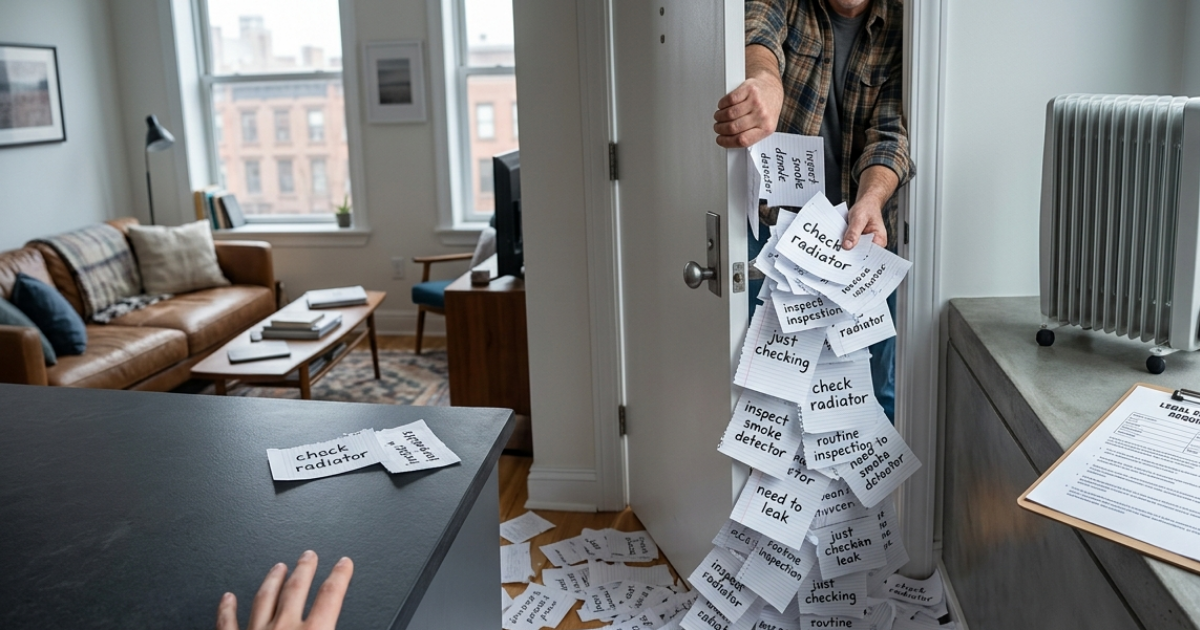
You're home on a Saturday morning when you hear a key in your lock. The door opens. It's your landlord, walking into your apartment unannounced. You're in your pajamas. You weren't expecting anyone. Your landlord says, "Oh, just checking the radiator," looks around for 30 seconds, and leaves. You're shaken, violated, angry.
This isn't the first time. Two weeks ago, they showed up claiming they needed to "inspect the smoke detector." Before that, they came by to "check for a leak" that doesn't exist. Last month, they entered while you weren't home—you only know because things were moved. Sometimes they text you an hour before showing up. Sometimes they leave a note on your door the same morning. Sometimes there's no notice at all.
Each time, there's an excuse: "emergency," "maintenance," "inspection," "just checking on something." But the excuses feel thin. The pattern is clear: your landlord enters your apartment whenever they want, with little or no notice, for reasons that don't seem legitimate. You feel like you have no privacy in your own home. You can't relax because you never know when they'll walk in.
You think: "Can they just do this? Don't I have any right to privacy? Is this legal? Or is this harassment? How do I make it stop without making things worse?"
Here's the truth: In New York, landlords must give reasonable notice and have legitimate reasons to enter your apartment. Repeated entries with little or no notice violate your right to privacy, and when it's a pattern, it constitutes illegal harassment and potentially trespass. Your landlord's behavior is not legal, and you have specific legal remedies to stop it.
Let me show you exactly what entry rights landlords actually have, when entries cross the line into harassment and privacy violations, how to document this pattern, and what you can do to stop it.
What Landlords Are Actually Allowed to Do
Before identifying violations, let's establish what's legal:
Legal Entry Scenario 1: True Emergencies (No Notice Required)
Landlords may enter WITHOUT advance notice only in genuine emergencies:
What qualifies as emergency:
- Fire or smoke in building
- Major water leak (pipe burst, flooding)
- Gas smell or suspected gas leak
- Structural collapse or immediate safety threat
- Any situation requiring immediate action to prevent serious harm
Why notice isn't required:
- Emergency situations can't wait for 24-hour notice
- Immediate action necessary to prevent damage or injury
- Time delay could make situation worse
Key limitation: It must be an ACTUAL emergency, not landlord's convenient excuse
Red flags suggesting fake emergency:
- "Emergency" doesn't seem urgent (landlord takes time to chat, look around casually)
- No evidence of actual emergency condition
- "Emergencies" happen repeatedly (convenient pattern)
- Landlord later can't explain what emergency was
- No repair work actually done to address claimed emergency
Example of real emergency:
- Downstairs neighbor reports water dripping from ceiling
- Leak source could be your apartment
- Landlord enters to check for burst pipe
- This is legitimate emergency requiring immediate access
Example of fake emergency:
- Landlord texts "emergency inspection" with no explanation
- Shows up, looks around, claims "checking for leak"
- No actual leak, no investigation, no repair
- Just excuse for unannounced entry
Legal Entry Scenario 2: Legitimate Purposes with Reasonable Notice
For non-emergencies, landlords may enter WITH proper advance notice for:
Making Necessary Repairs
Legitimate repair situations:
- Repairs landlord is legally required to make
- Repairs you requested
- Preventive maintenance that's genuinely necessary
Required notice:
- At least 24 hours advance notice (standard in NYC, though not specified in statute)
- Notice must be in writing (email, letter, text with details)
- Must state: specific date, specific time window (e.g., "Tuesday 10am-12pm"), specific purpose (what repair)
Example of proper notice for repairs: "I will be entering your apartment on Tuesday, March 15 between 10am-12pm to repair the leaking faucet you reported. My plumber will accompany me."
Legally Required Inspections
What qualifies:
- Annual smoke detector and carbon monoxide detector inspections (NYC law requires)
- Lead paint inspections in certain circumstances
- Bedbug inspections when there's evidence of infestation
- Other inspections mandated by law or regulation
Required notice:
- Same as repairs: 24-hour written notice with date, time, purpose
What doesn't qualify as "legally required inspection":
- Random "just checking on apartment" visits
- Landlord's personal desire to "see how things are"
- "Inspections" with no legal or regulatory basis
Showing Apartment to Prospective Tenants or Buyers
When this is allowed:
- If your lease is ending and you're not renewing
- If building is being sold
- If your lease permits showings (check your lease)
Required notice:
- 24-hour written notice with date, time, purpose
- Reasonable hours (not early morning or late evening)
- Reasonable frequency (not daily showings)
Limitations:
- Can't show apartment constantly
- Can't show during unreasonable hours
- Can't use "showings" as excuse for harassment
What "Reasonable Notice" Actually Means
While NY doesn't specify exact hours in statute, standard practice in NYC is:
Timing: At least 24 hours advance notice
- Not same-day notice
- Not one-hour notice
- Not showing up and claiming you "tried to call earlier"
Format: Written notice
- Email, text with details, letter, or formal notice
- Verbal notice alone is questionable
- "I knocked yesterday" is not proper notice
Content of notice must include:
- Specific date: "Tuesday, March 15" (not "sometime this week")
- Specific time window: "between 10am-12pm" (not "in the morning")
- Specific reason: "to repair kitchen faucet leak" (not "to check on things")
- Who will enter: landlord, super, contractor, etc.
Hours: Reasonable daytime hours
- Generally 9am-6pm weekdays
- 10am-5pm weekends (if you agree)
- Not early morning (before 8am)
- Not evening (after 7pm)
Example of proper notice:
✅ GOOD: "I will be entering your apartment on Thursday, March 17 between 2pm-4pm to repair the broken radiator valve. My heating contractor will accompany me."
- Sent via email Tuesday, March 15 (48 hours notice)
- Specific date, time, reason
- During reasonable hours
❌ BAD: Text sent 9am: "Coming by this morning to check something"
- Same-day notice (not 24 hours)
- Vague time ("this morning")
- Vague purpose ("check something")
❌ BAD: Landlord shows up unannounced and says "I tried to call you yesterday"
- No written notice
- Verbal attempt (if it even happened) isn't proper notice
- Showing up anyway after no response is not acceptable
When Repeated Entries Become Harassment and Privacy Violations
Let's identify when landlord entry crosses from "lawful but annoying" to "illegal harassment":
Legal Standard for Entry-Based Harassment
NYC harassment regulations and NY tenant rights law recognize:
"Pattern and practice of unauthorized entry" as harassment
Unauthorized entry includes:
- Entry without any notice
- Entry with inadequate notice (same-day, one-hour)
- Entry for pretextual reasons (fake emergencies, unnecessary "inspections")
- Entry at unreasonable hours
- Entry after tenant has objected to unannounced access
When it becomes harassment:
- Pattern: Multiple unauthorized entries over time, not isolated incident
- Frequency: Repeated entries (weekly, multiple times per month)
- Intent: Appears designed to intimidate, surveil, or pressure tenant
- Impact: Interferes with tenant's privacy, peace, and quiet enjoyment
Landlord Trespass
Beyond harassment, repeated unauthorized entry is also trespass:
Trespass elements:
- Landlord enters your apartment
- Without your permission
- Without legal right to enter (no emergency, no proper notice)
Even though landlord owns the building, they commit trespass by entering your apartment without legal right:
- Your lease gives you possessory rights
- Landlord's ownership doesn't override your right to exclude others
- Unauthorized entry violates your possessory rights = trespass
Trespass is both:
- Civil wrong (you can sue for damages)
- Potentially criminal (though rarely prosecuted in landlord-tenant context)
Privacy Rights Violation
Your right to privacy in your home is fundamental:
NY courts recognize:
- Tenant's right to quiet enjoyment includes privacy
- Right to be free from unreasonable intrusions
- Right to exclude others (including landlord) from your space
Repeated unauthorized entries violate these rights:
- Interfere with your ability to live peacefully
- Create constant anxiety about intrusion
- Deprive you of sense of security in your own home
Identifying the Pattern: Red Flags That This Is Harassment
How to know if landlord's entries are harassment vs. unfortunate mistakes:
Red Flag 1: Frequency of Entries
One unauthorized entry:
- Could be mistake or misunderstanding
- Annoying but probably not harassment
- Still violation of your rights, but isolated
Multiple entries over short period:
- Weekly unannounced visits
- Multiple times per month
- Pattern of repeated entries
Example patterns suggesting harassment:
Scenario A:
- March 5: Landlord enters claiming "emergency inspection" (no emergency)
- March 12: Landlord enters to "check radiator" (no notice given)
- March 20: Landlord enters while you're at work (you discover this when you get home)
- March 28: Landlord shows up claiming "leak check" (no leak)
Analysis: 4 entries in one month, minimal or no notice, pretextual reasons. This is harassment pattern.
Scenario B:
- One entry 6 months ago for legitimate repair with proper notice
- No entries since
Analysis: Single entry with legitimate purpose. Not harassment pattern.
Red Flag 2: Lack of Proper Notice
Pattern of inadequate notice:
- Consistent same-day notices
- Text messages 1-2 hours before entry
- No notice at all (just shows up)
- "Notice" left on door same morning as entry
Proper notice should be standard, not exception:
- If landlord rarely or never gives proper 24-hour written notice
- Pattern shows disregard for notice requirement
- Suggests harassment rather than occasional oversight
Red Flag 3: Pretextual or Vague Reasons
Legitimate reasons are specific:
- "Repair leaking faucet"
- "Annual smoke detector inspection required by law"
- "Fix broken radiator valve"
Pretextual reasons are vague or false:
- "Just checking on things"
- "Routine inspection" (with no legal requirement)
- "Emergency" that turns out not to be emergency
- "Checking for leak" that doesn't exist
- Different excuse each time
Pattern of pretextual reasons:
- Reasons don't match actual activity (claims "repair" but does nothing)
- Excuses change or can't be verified
- "Emergencies" that aren't urgent
- No follow-up work for claimed purpose
Example:
- Landlord claims "checking for water damage"
- Looks around briefly, takes photos of your belongings
- No water damage exists, no repair scheduled
- Real purpose appears to be surveillance, not maintenance
Red Flag 4: Entry at Unreasonable Hours
Proper entry: Reasonable daytime hours
- 9am-6pm weekdays
- If agreed, 10am-5pm weekends
Harassment indicators:
- Early morning entries (before 8am)
- Evening entries (after 7pm)
- Weekend entries without agreement
- Late-night entries (extreme violation)
Pattern of unreasonable timing:
- Entries timed when you're likely vulnerable (early morning getting ready, evening relaxing)
- No respect for reasonable hours
- Suggests intent to disturb rather than accomplish legitimate purpose
Red Flag 5: Entries Continue After You've Objected
Key harassment indicator:
You tell landlord to give proper notice:
- Send written request for 24-hour notice
- State you don't consent to unannounced entry
- Clearly communicate boundaries
Landlord ignores your request:
- Continues unannounced entries
- Gives same-day "notice"
- Shows up without notice despite your objection
Violation of stated boundaries proves harassment:
- Shows contact/entry is unwanted
- Demonstrates landlord's disregard for your rights
- Proves intent to harass (continuing despite clear objection)
Red Flag 6: Surveillance-Style Behavior
Entry appears designed to monitor you:
- Landlord looks through your belongings
- Takes photos of your personal items
- Comments on your lifestyle, possessions, visitors
- Checks on you rather than checking apartment
- Asks intrusive questions
Pattern suggests:
- Purpose is surveillance, not maintenance
- Harassment designed to make you feel watched
- Invasion of privacy beyond entry itself
Red Flag 7: Entries Connected to Other Harassment or Retaliation
Timing suggests retaliation:
- Unannounced entries start after you complained about repairs
- Increase after you filed HPD complaint
- Begin after you refused buyout
- Escalate after you asserted tenant rights
Combined with other harassment:
- Unannounced entries + excessive contact
- Entries + service interruptions
- Entries + threats or pressure
- Part of larger harassment campaign
Pattern reveals intent:
- Entries are tools of harassment/retaliation
- Not about legitimate property management
- Designed to pressure, intimidate, or punish
How to Protect Yourself: Documentation and Boundaries
If you're experiencing repeated unauthorized entries:
Action 1: Document Every Entry Meticulously
Create detailed entry log:
For each entry, record:
Date and exact time:
- "March 15, 2024, 10:32am"
- Note both entry time and departure time if possible
Notice given (or not):
- "No notice"
- "Text sent at 9:15am same day (1 hour notice)"
- "Email sent March 14 at 6pm (16 hours notice, less than 24 required)"
Who entered:
- Landlord alone
- Landlord with contractor
- Super
- Unknown person
Stated reason:
- What landlord claimed entry was for
- Quote directly if possible: "Landlord said 'just checking on the apartment'"
What they actually did:
- "Looked around for 30 seconds, left"
- "Claimed to check smoke detector but didn't touch it"
- "Walked through apartment, took photos"
- "Actually repaired faucet"
Whether reason was legitimate:
- "No actual emergency existed"
- "No repair was needed or performed"
- "Stated reason doesn't match activity"
Whether you were home:
- "I was home, in pajamas when landlord entered"
- "I was at work, discovered entry when I got home (items moved)"
How you learned about entry:
- "Landlord unlocked door while I was home"
- "Noticed items moved, landlord later admitted entering"
- "Neighbor told me they saw landlord enter"
Your response:
- "Told landlord they need to give 24-hour notice"
- "Did not consent to entry"
- "Objected but landlord insisted"
Impact on you:
- "Felt violated and unsafe"
- "Can't relax at home, always worried about intrusion"
- "Anxiety about getting dressed or being home alone"
Example log entry:
March 15, 2024
Time: 10:32am entry, 10:34am departure
Notice: None. Landlord showed up unannounced.
Who: Landlord alone
Stated reason: "Need to check for leak"
What happened: Landlord unlocked door while I was home in my bathrobe. Walked through living room and kitchen, looked around briefly, said "everything looks fine," left. Total time: 2 minutes. Did not check any pipes or plumbing. No leak exists or was investigated.
Legitimate purpose: No. No leak, no actual inspection, pretextual reason.
My response: Told landlord they need to give me 24-hour notice for non-emergency entry. Landlord said "I own the building, I can check on my property."
Impact: Felt extremely violated. I was not dressed. Had no warning. Can't feel safe in my own home. This is the 4th unannounced entry this month.
Why this documentation is critical:
Proves pattern:
- Shows frequency of entries over time
- Demonstrates repeated violations
- Captures escalation
Proves lack of legitimate purpose:
- Compares stated reasons to actual activity
- Shows pretextual nature of entries
- Documents fake emergencies
Proves inadequate notice:
- Records amount of notice (or lack thereof)
- Shows systematic failure to give proper notice
- Documents disregard for legal requirements
Evidence for legal action:
- This log is your primary evidence in harassment case
- Courts require documentation of pattern
- HPD uses this to investigate complaints
Save additional evidence:
- Screenshots of any text "notices"
- Emails from landlord about entries
- Photos of notes left on door
- Witness statements from neighbors who saw entries
- Photos showing items moved (proves entry when you weren't home)
Action 2: Set Clear Written Boundaries
Send formal notice establishing entry requirements:
Template:
"[Date]
Dear [Landlord],
I am writing to formally establish clear procedures for entry to my apartment at [address].
Legal Entry Requirements:
You may enter my apartment under the following circumstances:
1. With Proper Advance Notice: For non-emergency purposes (repairs, legally required inspections, showings if my lease permits), you must provide:
- At least 24 hours advance written notice (via email or written letter)
- Stating the specific date and time window (e.g., "Tuesday, March 20, 10am-12pm")
- Stating the specific reason for entry
- Entry must be during reasonable daytime hours (9am-6pm Monday-Friday)
2. True Emergencies Only: You may enter without notice only in case of actual emergency requiring immediate action (fire, major leak, gas smell, or other immediate safety threat).
Unauthorized Entry Not Permitted:
I do not consent to unannounced entry or entry with inadequate notice. "Checking on things," "routine inspections," and similar vague purposes do not constitute emergencies or legal requirements permitting entry without proper notice.
Recent Pattern:
I have experienced [number] unauthorized entries to my apartment in the past [timeframe], including entries on [dates]. These entries occurred with little or no notice and for pretextual or vague reasons. This pattern is unacceptable and must stop immediately.
Going Forward:
I expect you to comply with proper entry procedures as outlined above. Continued unauthorized entry constitutes harassment and trespass, and I will report such conduct to appropriate authorities and seek legal remedies if necessary.
I am documenting all communications and entry attempts.
Please confirm your understanding and agreement to follow proper entry procedures going forward.
[Your Name] [Date]"
Why this letter is crucial:
Creates legal record:
- Proves you clearly stated boundaries
- Shows you know your rights
- Establishes proper entry procedures
Makes future entries clearly unauthorized:
- After this letter, any violation of stated procedures is knowingly unauthorized
- Strengthens harassment and trespass claims
- Can't claim they "didn't know" you objected
Documents pattern:
- Notes recent unauthorized entries
- Puts landlord on notice you're documenting
- Creates timeline for legal action
Professional and measured:
- Not aggressive or inflammatory
- States legal requirements factually
- Can be shown to judge/authorities and reflects well on you
Send via email and save confirmation. Consider also sending via certified mail for additional proof of delivery.
Action 3: Refuse Entry for Improper Attempts (With Cautions)
When landlord shows up without proper notice:
If you're home when landlord arrives:
Don't open door fully:
- Speak through door or open with chain lock
Ask about notice and purpose: "Did you provide 24-hour written notice for this entry? What is the specific purpose?"
If no proper notice and no genuine emergency: "You did not provide the required 24-hour notice. Unless this is a genuine emergency requiring immediate action, I do not consent to entry. Please leave and contact me with proper notice to reschedule."
If landlord claims "emergency": "What is the specific emergency?" Listen to response. If clearly not emergency: "That is not an emergency requiring immediate entry without notice. Please leave and provide proper notice."
If landlord enters anyway despite your refusal:
- Don't physically block (safety concern)
- State clearly: "I do not consent to this entry"
- Document: time, what happened, what was said
- This is evidence of trespass and harassment
Important safety considerations:
If you feel threatened:
- Don't confront aggressive landlord
- Call 911 if you feel unsafe
- Your safety is more important than establishing boundaries in the moment
- Document threatening behavior afterward
If landlord has key and enters while you're not home:
- You can't physically prevent this
- Document that unauthorized entry occurred
- Consider changing locks (check lease first—some leases prohibit this; if you change locks, you must provide landlord with key in most cases)
Action 4: Report to Authorities
If unauthorized entries continue despite your written boundaries:
In NYC: Report to HPD
Call 311: "I want to report tenant harassment. My landlord is repeatedly entering my apartment without proper notice. I sent written request for proper entry procedures [date], but unauthorized entries continue. I have detailed documentation."
Specifically mention:
- Frequency of unauthorized entries
- Pattern of inadequate or no notice
- Pretextual reasons
- You've set clear boundaries in writing
- Landlord is ignoring your stated requirements
What HPD does:
- Creates harassment complaint file
- May investigate
- May contact landlord
- Documents official record of harassment
File Housing Maintenance Complaint:
- In addition to harassment report
- Note unauthorized entries as privacy violations
- Creates additional official record
Outside NYC: Contact Local Authorities
Local code enforcement or housing authority:
- File harassment complaint
- Provide documentation
Police (for severe cases):
- If entries are threatening or feel like stalking
- If landlord refuses to leave when you ask
- Creates police report of trespass
Contact NY Attorney General
AG's Tenant Protection Unit:
- Investigates harassment patterns
- May take enforcement action
- Particularly relevant if multiple tenants affected
Action 5: Get Legal Help
Contact legal services:
NYC:
- Legal Services NYC: 917-661-4500
- Legal Aid Society: 212-577-3300
- Housing Court Answers: 212-962-4795
- Met Council on Housing: 212-979-0611
Outside NYC:
Tell intake: "My landlord is harassing me through repeated unauthorized entries to my apartment. They enter with little or no notice, multiple times per month, for pretextual reasons. I've set written boundaries, but entries continue. I have detailed documentation."
What lawyers can do:
Send cease and desist letter:
- Formal letter demanding landlord stop unauthorized entries
- Cites trespass and harassment law
- Warns of legal action if pattern continues
File HP harassment proceeding:
- Court case seeking order prohibiting unauthorized entries
- Request civil penalties against landlord
- Seek restraining order if severe
Sue for trespass and harassment:
- Civil lawsuit seeking damages
- Compensation for invasion of privacy
- Punitive damages to deter future conduct
Seek injunction:
- Court order prohibiting landlord from entering without proper procedures
- Contempt if landlord violates court order
Special Issues: Retaliation and Escalation
Watch for retaliation after you assert your rights:
If You Set Boundaries and Landlord Retaliates
Common retaliation:
- Refuses to renew lease
- Dramatically increases rent
- Suddenly "discovers" lease violations
- Refuses to make repairs
- Files eviction
Document retaliation:
- Timeline: boundary letter → retaliatory action
- Proves retaliatory motive
- RPL § 223-b prohibits retaliation for asserting tenant rights
Your defense:
- Asserting right to privacy is protected activity
- Landlord can't retaliate for you requiring proper entry procedures
- Timing proves retaliation
If Entries Escalate After You Object
Sometimes landlord doubles down:
- More frequent entries after boundary letter
- More aggressive entry attempts
- Threatening behavior during entries
This actually strengthens your case:
- Shows deliberate disregard for your rights
- Proves harassment intent
- Creates urgency for court intervention
Get immediate legal help:
- May need emergency restraining order
- Escalation suggests serious harassment requiring immediate court action
The Truth About Entry-Based Harassment
Here's what you need to know:
Landlords do NOT have unlimited right to enter just because they own the building. Your lease gives you possessory rights that landlords must respect.
Proper notice and legitimate purpose are required for all non-emergency entry. This is standard NYC practice and tenant rights principle.
Repeated unauthorized entry is both harassment and trespass. You have legal remedies for both.
Your written boundary letter is crucial. It transforms entries from "arguably reasonable" to "clearly unauthorized and illegal."
Documentation is everything. Your entry log is evidence proving pattern for legal action.
You have the right to privacy in your home. This includes the right to control who enters and when.
Landlords who continue entering after you've set boundaries face serious legal consequences: court orders, civil penalties, damages, contempt charges.
Taking action protects you and other tenants. Landlords who aren't held accountable continue harassing behavior.
Free legal help is available. Use it.
Document entries. Set boundaries in writing. Report harassment. Get legal help. Stop the invasions of your privacy.
Your home is your sanctuary. You have the legal right to peaceful enjoyment without constant unwanted intrusion.
Defend that right.
Find out if you have a case in 30 seconds →