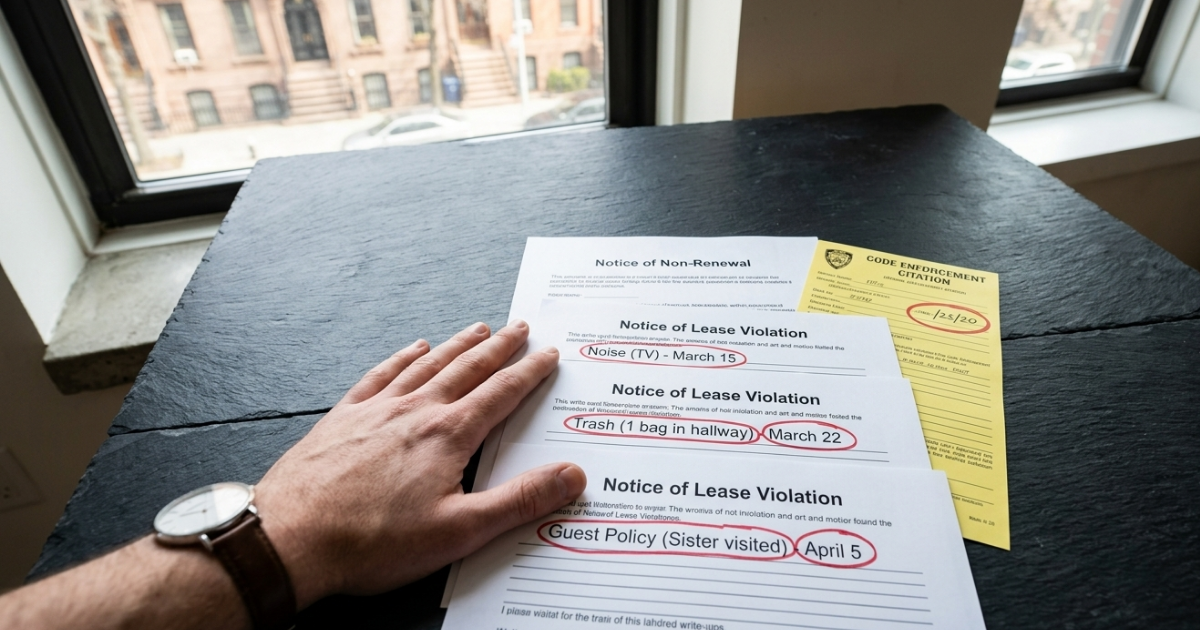
You finally had enough. The broken heat, the mold spreading across your bedroom wall, the mice in the kitchen—you asked your landlord to fix these problems for months and got nothing but excuses and delays. So you did what you had the legal right to do: you called code enforcement. An inspector came, documented the violations, and issued citations to your landlord.
Then the retaliation started.
Your landlord knocked on your door the next week saying, "I don't know if I'm going to renew your lease after what you did." A few days later, you got a written "warning" about noise—even though you've never been loud and neighbors have been louder for years without consequences. The week after that, another write-up claiming you left trash in the hallway (you didn't). Then another for a "guest policy violation" because your sister visited for the weekend. The warnings keep coming for things that were never issues before, things other tenants do without getting written up, minor infractions that your landlord suddenly cares about deeply.
Each time, your landlord mentions not renewing your lease. The message is clear: "You shouldn't have called the city. Now you're going to pay for it."
You're scared. You think: "They're going to build a case against me with all these write-ups. Then they'll refuse to renew and say it's because I'm a problem tenant, not because I called code enforcement. How can I prove it's really retaliation? Can they do this? Do I have any protection?"
This scenario—threatening non-renewal combined with a sudden campaign of documenting minor or fabricated violations after you report code issues—is one of the most sophisticated and pernicious forms of landlord retaliation.
Here's the truth: What your landlord is doing is exactly the kind of conduct that New York retaliation and harassment laws are designed to prohibit. Threatening non-renewal, actually refusing to renew, and creating a pattern of write-ups to justify that non-renewal after you call code enforcement is illegal retaliation.
The law doesn't just protect you from direct retaliation—it protects you from this exact pretextual pattern. The write-ups are being created to manufacture a fake paper trail justifying retaliation disguised as "legitimate business decision not to renew a problem tenant."
Let me show you exactly why this is illegal, how the one-year retaliation presumption protects you, how courts analyze patterns like this, and what you need to do right now to protect yourself.
Why This Pattern Is Textbook Retaliation
Before we get to the legal framework, let's understand the retaliation tactic your landlord is using:
The Sophisticated Retaliation Strategy
Crude retaliation (that landlords know is obviously illegal):
- "You called code enforcement, so I'm not renewing your lease."
- Direct admission that non-renewal is punishment for complaint
Sophisticated retaliation (what your landlord is doing):
- You call code enforcement
- Landlord starts "documenting" violations
- Multiple write-ups for minor or fabricated issues
- Landlord creates paper trail showing you're "problem tenant"
- Landlord refuses to renew citing "pattern of lease violations"
- Landlord claims it's "not about the code complaint—look at all these violations"
Why landlords use this tactic:
- Creates plausible deniability ("I'm not retaliating, I'm enforcing lease")
- Appears legitimate on surface (documented violations)
- Makes you look like problem tenant rather than victim of retaliation
- Discourages other tenants from reporting violations (they see what happened to you)
Why it's still illegal retaliation despite the sophistication:
- Timing reveals true motive (pattern started after code complaint)
- Selective enforcement (you get written up for things others don't)
- Pretextual nature (violations are minor, fabricated, or previously tolerated)
- Pattern shows campaign of retaliation, not legitimate enforcement
Courts are not fooled by this tactic. The law specifically accounts for pretextual retaliation disguised as legitimate lease enforcement.
Why Landlords Think This Will Work
Landlords believe:
- "If I create enough documentation of violations, I can justify non-renewal"
- "Courts will believe my paper trail over tenant's claims of retaliation"
- "Timing won't matter if I have 'legitimate' grounds"
- "Tenant won't be able to prove the violations are fabricated"
What landlords don't understand:
- Courts look at timing and pattern, not just individual violations
- Sudden change in enforcement after code complaint is evidence of retaliation
- Selective enforcement (writing you up but not other tenants) proves pretext
- One-year presumption shifts burden to landlord to prove non-retaliation
- Pattern of violations created after complaint actually strengthens retaliation claim
Why You're Scared This Might Work
You're worried:
- "They have all these write-ups documenting violations"
- "How do I prove the violations are fake or exaggerated?"
- "How do I prove other tenants do the same things without consequences?"
- "Landlord will show judge the file of violations and say 'see, problem tenant'"
- "Judge will believe the documentation over my word"
What you don't know:
- Timing matters more than documentation
- Pattern of sudden enforcement after complaint proves retaliation
- Burden shifts to landlord to prove violations are legitimate, not pretextual
- You have legal tools to challenge each write-up as fabricated or selective
- Courts see this tactic frequently and know how to identify it
What New York Law Says About This Type of Retaliation
Let's establish the legal framework:
The Core Anti-Retaliation Statute: RPL § 223-b
Real Property Law § 223-b prohibits landlords from:
Evicting you, OR Refusing to renew your lease, OR
Attempting to substantially alter the terms of the tenancy, OR Otherwise retaliating against you
Because you:
Made good-faith complaints about health, safety, or code violations to government agencies (code enforcement, HPD, housing inspectors, health department, building department, etc.)
"Otherwise retaliating" explicitly includes:
- Threats of non-renewal
- Actual non-renewal
- Harassment campaigns
- Pretextual enforcement of lease provisions
- Creating documentation to justify retaliation
How the Law Applies to Your Situation
Your protected activity: ✓ You called code enforcement about health/safety/code violations ✓ This is explicitly protected under RPL § 223-b
Landlord's retaliatory actions: ✓ Threatening not to renew (verbal threats) ✓ Pattern of write-ups that started after your code complaint ✓ Write-ups appear pretextual (minor issues, fabricated issues, previously tolerated conduct, selective enforcement)
Legal analysis: This is prohibited retaliation. Both the threats and the write-up pattern constitute "otherwise retaliating" under the statute.
The One-Year Retaliation Presumption
This is your most powerful protection:
If within approximately one year after your good-faith complaint to code enforcement, landlord:
- Serves non-renewal or termination notice, OR
- Starts eviction case, OR
- Attempts to substantially change tenancy terms
The law creates a rebuttable presumption that the action is retaliatory.
What "rebuttable presumption" means:
Presumption: Court assumes landlord is retaliating based on timing alone
Rebuttable: Landlord can try to disprove presumption by proving legitimate non-retaliatory grounds
Burden shifts to landlord: Landlord must prove they have genuine, non-retaliatory reasons for non-renewal/eviction
If landlord can't meet this burden: Action is deemed retaliatory and blocked
How Presumption Applies to Threats and Write-Ups
Even before formal non-renewal notice:
Threats of non-renewal after code complaint:
- Evidence of retaliatory intent
- Shows landlord's motive
- Strengthens retaliation claim when actual notice comes
Pattern of write-ups after code complaint:
- Evidence of retaliatory campaign
- Pattern shows landlord creating pretextual justification
- Timing proves write-ups are retaliation, not legitimate enforcement
If/when landlord actually serves non-renewal notice:
- Presumption automatically applies (within one year of complaint)
- Landlord must prove non-renewal isn't retaliation
- Landlord will point to write-ups as "legitimate grounds"
- You challenge write-ups as pretextual and part of retaliation pattern
- Court analyzes timing and pattern to determine if write-ups are legitimate or retaliatory
How Courts Analyze Write-Up Patterns as Retaliation
When landlords use manufactured violations to justify retaliation, courts look at specific factors:
Factor 1: Timing of When Write-Ups Started
Courts compare:
Before code complaint:
- How often did landlord document violations?
- What types of violations were enforced?
- How many write-ups did you receive?
After code complaint:
- When did first write-up occur relative to complaint?
- How many write-ups since complaint?
- What's the frequency pattern?
Red flag patterns suggesting retaliation:
Sudden enforcement after complaint:
- Zero or minimal write-ups before complaint
- Multiple write-ups after complaint
- First write-up within days/weeks of code complaint
Example:
- Lived in apartment 3 years, zero write-ups
- Called code enforcement March 1
- First write-up March 10 (9 days later)
- Second write-up March 25
- Third write-up April 5
- Fourth write-up April 20
Analysis: Clear pattern. Zero enforcement in 3 years, then sudden campaign of write-ups immediately following code complaint. Timing proves retaliation.
Increased frequency after complaint:
- Occasional write-ups before complaint (maybe 1-2 per year)
- Frequent write-ups after complaint (multiple per month)
Example:
- One write-up in Year 1, one in Year 2
- Called code enforcement in Year 3, Month 1
- Six write-ups in the 3 months since complaint
Analysis: Dramatic increase in frequency after complaint. Pattern shows retaliatory campaign.
Factor 2: Nature of Alleged Violations
Courts examine whether violations are:
Real vs. Fabricated
Real violations:
- Tenant actually did what landlord claims
- Evidence supports allegation
- Violation is documented with photos, witnesses, contemporaneous records
Fabricated violations:
- Tenant didn't do what landlord claims
- No evidence supports allegation
- Landlord's only "proof" is their own statement
- Tenant has evidence contradicting allegation
Example of fabricated write-up:
- Write-up claims: "Tenant left trash in hallway on March 15"
- Tenant's evidence: Was out of town March 14-17, has airline tickets and hotel receipts proving it
- Analysis: Impossible for tenant to have violated rule. Write-up is fabricated retaliation.
Substantial vs. Minor
Substantial violations:
- Create safety hazards
- Damage property
- Seriously disturb other tenants
- Violate law
Minor violations:
- Technical lease violations
- Inconsequential issues
- Matters of preference rather than safety/habitability
Example of minor violations used pretextually:
- Write-up for leaving bike in hallway overnight (picked up next morning)
- Write-up for recycling bin lid not fully closed
- Write-up for doormat being 2 inches into hallway
- Write-up for package left in vestibule for 3 hours
Analysis: These are trivial matters that don't justify non-renewal. Landlord is documenting minutiae to create appearance of problem tenant.
Previously Tolerated vs. Newly Enforced
Courts look at landlord's enforcement history:
Previously tolerated conduct:
- Tenant engaged in same conduct before complaint without consequences
- Landlord knew about conduct and didn't object
- Landlord explicitly or implicitly approved conduct
Newly enforced after complaint:
- Same conduct now triggers write-ups
- Sudden "discovery" of violations that existed before
- New interpretation of lease provisions
Example:
- Tenant has had guests stay for weekends throughout 2-year tenancy
- Landlord never mentioned guest policy
- Tenant calls code enforcement
- Week later, write-up for "guest policy violation—sister stayed Friday-Sunday"
- Analysis: Conduct was tolerated for 2 years. Sudden enforcement after code complaint proves retaliation, not legitimate lease enforcement.
Factor 3: Selective Enforcement
Courts examine whether violations are enforced uniformly or selectively:
Uniform enforcement:
- All tenants engaging in conduct get written up
- Rules applied consistently
- Similar violations treated similarly
Selective enforcement against complaining tenant:
- Only you get written up for conduct others engage in
- Other tenants do same things without consequences
- Enforcement is targeted at you specifically
Example:
- You get write-up for noise (normal living sounds)
- Neighbor above you stomps loudly daily—no write-up
- Neighbor next door has loud parties—no write-up
- Only you, the tenant who called code enforcement, get noise write-ups
Analysis: Selective enforcement proves retaliation. If violations were truly about lease enforcement, all violators would be written up. Targeting only the complaining tenant reveals retaliatory motive.
How to prove selective enforcement:
- Witness testimony from neighbors about their conduct
- Your observations of other tenants' violations
- Testimony that you're only one getting written up
- Ask landlord in court: "Do you write up other tenants for noise/guests/trash?"
Factor 4: Pretextual Nature of Violations
Courts assess whether violations are genuine enforcement or pretextual:
Pretextual indicators:
Vague or subjective allegations:
- "Tenant is disruptive" (no specific incidents)
- "Tenant shows bad attitude" (not lease violation)
- "Tenant doesn't maintain apartment to standard" (what standard?)
Violations that can't be verified:
- Claims about conduct with no witnesses or evidence
- "He said/she said" situations where only landlord claims violation
- Allegations that conveniently have no documentation
Inconsistent allegations:
- Write-up claims one thing, later landlord changes story
- Details don't match up
- Timeline doesn't make sense
Violations immediately following each other:
- Multiple write-ups in rapid succession
- Suggests landlord is looking for anything to document
- Creating volume of complaints rather than responding to actual issues
Example of pretextual pattern:
- Week 1 write-up: noise
- Week 2 write-up: trash
- Week 3 write-up: guest
- Week 4 write-up: late rent (but you paid on time)
- Week 5 write-up: unauthorized alteration (you hung picture)
Analysis: Rapid-fire write-ups for unrelated issues, some fabricated, some trivial, some previously tolerated. Pattern shows landlord is documenting anything possible to build case, not legitimately enforcing lease.
Factor 5: Landlord's Statements Revealing Motive
Direct evidence of retaliation (landlord says the quiet part out loud):
Explicit connections between code complaint and consequences:
- "You called code enforcement, so I'm watching you closely now"
- "If you're going to report me, I'm going to enforce every lease rule"
- "You made your choice when you called the city—now deal with consequences"
- "Don't be surprised when I don't renew after what you did"
Threats tying write-ups to code complaint:
- "I'm documenting everything now that you've reported me"
- "I never cared about these things before, but now I do"
- "You want to make my life difficult? I'll make yours difficult"
Example:
- Tenant calls code enforcement March 1
- Landlord confronts tenant March 5: "I know you called the city. Bad move. I'm going to be watching everything you do from now on."
- Write-ups start March 10
Analysis: Landlord's statement explicitly connects increased scrutiny/documentation to code complaint. Proves retaliatory motive.
Even without explicit statements, pattern speaks for itself:
- Timing + selective enforcement + pretextual nature = retaliation proven by circumstantial evidence
Real Example: How Courts See Through This Tactic
Let's examine a detailed scenario:
The Case
Background:
- Tenant lived in apartment 4 years
- Generally good tenant, paid rent on time
- Received one write-up in Year 2 for minor noise issue, nothing since
- Landlord knew tenant had dog entire tenancy (pet deposit paid)
The Code Complaint:
- February 1: Tenant reports mold, broken heat, and structural issues to code enforcement
- February 10: Inspector comes, finds violations
- February 15: Violations issued to landlord
The Retaliation Campaign:
February 20: Landlord knocks on door, says "I don't think this is working out. I probably won't renew your lease."
February 25: First write-up - "Unauthorized pet" (the dog landlord knew about for 4 years)
- Tenant's response: Shows landlord email from 4 years ago approving dog and receipt for pet deposit
March 5: Second write-up - "Excessive noise complaint from neighbor"
- Tenant's response: Neighbor (when asked) says they didn't complain
- Analysis: Fabricated complaint
March 15: Third write-up - "Trash left in hallway"
- Tenant's response: Was out of town that day, has proof
- Analysis: Impossible, fabricated
March 25: Fourth write-up - "Guest staying more than two weeks" (tenant's sister visiting 4 days)
- Tenant's response: Sister's visit was 4 days, has texts showing sister's arrival/departure dates
- Analysis: False allegation
April 1: Non-renewal notice citing "pattern of lease violations as documented"
How Court Analyzes This
Protected activity: ✓ Code enforcement complaint February 1
Timeline analysis:
- 4 years of tenancy: 1 minor write-up total
- Code complaint: February 1
- Violations issued: February 15
- Retaliation threats start: February 20 (5 days after violations issued)
- Write-up campaign begins: February 25 (10 days after violations issued)
- Non-renewal: April 1 (2 months after complaint)
Timing creates presumption: ✓ All adverse actions within one-year window
Nature of violations analysis:
"Unauthorized pet":
- Previously authorized 4 years ago
- Conduct tolerated entire tenancy
- Pretextual—suddenly "discovering" violation landlord approved years ago
"Noise complaint":
- Alleged complaining neighbor denies making complaint
- Fabricated
"Trash in hallway":
- Tenant has proof was out of town
- Impossible for tenant to have committed violation
- Fabricated
"Guest overstay":
- Actual visit: 4 days
- Alleged violation: over 2 weeks
- False allegation
Selective enforcement:
- Only tenant gets written up
- Other tenants have guests, pets, occasionally make noise—no write-ups
- Selective targeting of complaining tenant
Pattern analysis:
- Zero enforcement history for 4 years
- Sudden barrage of write-ups immediately after code complaint
- All violations are fabricated, exaggerated, or previously tolerated
- Rapid-fire documentation creating paper trail
- Landlord explicitly threatened non-renewal after code complaint
Court's conclusion:
Landlord is clearly retaliating.
- Timing proves it (immediate response to code complaint)
- Write-ups are pretextual (fabricated, previously tolerated, exaggerated)
- Pattern shows manufactured justification for retaliation
- Landlord's threats reveal true motive
Non-renewal is blocked as retaliatory.
- Landlord's claimed "legitimate grounds" (pattern of violations) are proven false
- Violations are part of retaliation, not genuine enforcement
- Landlord failed to overcome presumption
Tenant stays.
- Lease renews
- Landlord may be ordered to cease harassment
- Landlord may face penalties and attorney fees
What You Must Do Right Now
If you're experiencing this pattern, immediate action is critical:
Action 1: Document Your Code Complaint
Gather and save proof of your protected activity:
Code enforcement complaint:
- Complaint number(s)
- Date you filed complaint
- Method (called 311, emailed code enforcement, submitted online)
- Save confirmation emails, complaint numbers, any records
Inspection records:
- Date of inspection
- Inspector's name/agency
- What violations were found
- Violation notices issued to landlord
- Photos inspector took (request copies if possible)
Your prior repair requests:
- Emails, texts, letters to landlord requesting repairs before you called code enforcement
- Landlord's responses (or non-responses)
- Timeline showing you tried to get landlord to fix issues before involving authorities
Why this matters: Proves you engaged in protected activity (code complaint). Establishes the "before" timeline for comparing landlord's treatment of you before vs. after complaint.
Action 2: Create Comprehensive Timeline
Make detailed chronological document:
Format:
[Date]: [Event]
Example:
January 15, 2024: First noticed mold in bedroom, photographed
January 20, 2024: Emailed landlord requesting mold remediation
January 25, 2024: Landlord responded "will look into it"
February 1, 2024: No action from landlord, called code enforcement, complaint #123456
February 10, 2024: Code enforcement inspector came, found violations
February 15, 2024: Violations issued to landlord
February 20, 2024: Landlord knocked on door, said "probably won't renew your lease after what you did"
February 25, 2024: Received first write-up (unauthorized pet - dog landlord approved 4 years ago)
March 5, 2024: Received second write-up (noise - fabricated)
March 15, 2024: Received third write-up (trash - I was out of town, impossible)
[Continue with each write-up and threat]
Why this timeline is crucial:
- Visually shows the pattern: code complaint → violations → immediate retaliation
- Demonstrates sudden change in landlord's treatment after complaint
- Proves timing that triggers presumption
- Will be key evidence in court
Action 3: Document Every Write-Up in Detail
For each write-up, create a file containing:
The write-up itself:
- Save the actual notice/email/letter
- Note date you received it
- Note method of delivery
Your rebuttal evidence:
If violation is fabricated:
- Evidence proving you didn't do what's alleged
- Witnesses who can testify it didn't happen
- Records (receipts, timestamps, location data) proving impossibility
- Photos/videos disproving allegation
If violation is exaggerated:
- What actually happened vs. what landlord claims
- Evidence showing the minimal nature of actual conduct
- Context that explains why it's not really a violation
If violation is previously tolerated:
- Evidence landlord knew about conduct before
- Communications showing landlord approved or didn't object
- Photos/emails from before code complaint showing same conduct
- How long you've engaged in conduct without landlord objecting
If violation is selectively enforced:
- Evidence that other tenants do same thing without write-ups
- Your observations (dates, specifics) of others' violations
- Witness testimony from neighbors
- Photos showing other tenants engaging in same conduct
Example documentation for one write-up:
Write-up: "Tenant left trash in hallway March 15"
Rebuttal file:
- Copy of write-up (save it)
- Airline ticket showing flight departing March 14, returning March 17
- Hotel reservation confirmation for March 14-17
- Credit card statement showing purchases in different city on March 15
- Neighbor's statement: "I saw the tenant leave with luggage March 14"
- Analysis note: "Impossible for me to have left trash when I was in another city. This write-up is fabricated."
Organize all write-ups: Create master document listing each write-up with your rebuttal for each. This shows pattern when all violations are false/exaggerated/pretextual.
Action 4: Document Landlord's Threats and Statements
Record every threat and retaliatory statement:
If in writing (text, email):
- Save immediately
- Screenshot texts before they can be deleted
- Forward emails to secondary account
- Print copies
If verbal:
- Write down immediately after conversation
- Record: date, time, exact words (as best you can remember), context, witnesses
- Email yourself contemporaneous record
Particularly important statements:
- Threats of non-renewal
- Connections between code complaint and consequences
- Statements revealing retaliatory motive
- Admissions that enforcement is new/different after complaint
Example documentation:
"March 20, 2024, 6:30pm: Landlord came to door. Said: 'You really screwed up by calling code enforcement. I'm watching everything you do now, and I'm documenting it all. Don't expect me to renew your lease.' Witness: My roommate was present and heard this."
Action 5: Document Your Tenancy History
Prove you were "good tenant" before code complaint:
Rent payment history:
- Bank statements showing on-time rent payments
- Receipts from landlord
- No late payments or nonpayment issues
Prior enforcement history (or lack thereof):
- How many write-ups before code complaint? (ideally zero or very few)
- For what violations?
- How landlord treated you before complaint (good relationship, no issues)
Lease compliance:
- You followed lease terms
- No prior eviction attempts
- No prior serious complaints
Comparison evidence:
- Other tenants' conduct that doesn't get written up
- Building conditions showing rules aren't uniformly enforced
- Evidence that you're being singled out
Why this matters: Shows sudden change in landlord's treatment after code complaint. Undermines landlord's claim you're "problem tenant"—if you were problem tenant, why no write-ups for 4 years until after code complaint?
Action 6: Respond to Each Write-Up in Writing
Don't let write-ups go unchallenged:
Send written response to each write-up:
Template:
"[Date]
Dear [Landlord],
I received your notice dated [date] alleging [violation]. I dispute this allegation for the following reasons:
[Explain why allegation is false/exaggerated/previously tolerated/selectively enforced]
[Provide evidence: "I was out of town that day, see attached airline ticket" or "You approved this conduct four years ago, see attached email" or "Other tenants engage in same conduct without consequences"]
I note that this write-up follows my code enforcement complaint filed [date] and is part of what appears to be a retaliatory pattern prohibited under New York Real Property Law § 223-b.
I request that this write-up be removed from my file and that you cease retaliatory conduct.
[Your name]"
Why written responses matter:
- Creates record of your rebuttal
- Shows you're challenging violations in real-time
- Demonstrates violations are contested, not admitted
- References retaliation law, putting landlord on notice
- Provides evidence for court showing each write-up is false/pretextual
Action 7: Get Legal Help IMMEDIATELY
Don't wait until you get non-renewal notice:
Contact legal services now:
NYC:
- Legal Services NYC: 917-661-4500
- Legal Aid Society: 212-577-3300
- Housing Court Answers: 212-962-4795
- Metropolitan Council on Housing: 212-979-0611
Outside NYC:
- Use LawHelpNY.org to find legal services in your county
Tell intake: "My landlord is retaliating against me for calling code enforcement. They're threatening not to renew my lease and they've started writing me up for fabricated violations. I need help defending against retaliation under RPL § 223-b."
What lawyers will do:
Evaluate your evidence:
- Review timeline
- Assess strength of retaliation claim
- Analyze each write-up
- Determine best legal strategy
Send cease and desist letter:
- Lawyer can send letter to landlord citing retaliation law
- Demand landlord stop retaliatory conduct
- Put landlord on notice that you know your rights
- May deter actual non-renewal
Prepare for potential non-renewal or eviction:
- If landlord proceeds with non-renewal, lawyer will defend
- If landlord files eviction based on write-ups, lawyer will raise retaliation defense
- Evidence you've already gathered will be crucial
Consider affirmative legal action:
- In some cases, filing harassment proceeding before non-renewal
- Seeking court order prohibiting retaliation
- Proactive legal strategy
Action 8: If You Receive Non-Renewal Notice, Act IMMEDIATELY
CRITICAL: Do not ignore non-renewal notice
If landlord actually serves written non-renewal or lease termination:
Step 1: Contact your lawyer immediately (or get one if you don't have one yet)
Step 2: Do NOT move out
- Non-renewal notice doesn't mean you must leave
- Stay in apartment
- Continue paying rent
- Force landlord to go to court if they want you out
Step 3: Prepare retaliation defense
- Your timeline and documentation become court evidence
- Lawyer will file Answer (if landlord files eviction) raising retaliation under RPL § 223-b
- Presumption applies because non-renewal is within one year of code complaint
- Burden shifts to landlord to prove non-retaliation
Step 4: Challenge write-ups as pretextual
- Present evidence that each write-up is fabricated/exaggerated/previously tolerated
- Show pattern: zero enforcement before complaint, barrage after complaint
- Prove selective targeting
- Demonstrate landlord created false paper trail to disguise retaliation
What happens in court:
Landlord's argument: "This isn't retaliation. Tenant has pattern of lease violations. See all these write-ups."
Your argument: "These write-ups are part of the retaliation. They were created after my code complaint to manufacture justification for retaliatory non-renewal. [Present timeline, evidence of fabrication, selective enforcement, etc.]"
Court's analysis: Examines timing and pattern. If write-ups started after complaint, are fabricated/pretextual, and target only you—court concludes write-ups are part of retaliation scheme, not legitimate grounds.
Likely outcome: Non-renewal blocked as retaliatory. You stay in apartment. Landlord may face penalties.
Special Considerations: Harassment Law Also Applies
Your situation may violate both retaliation law AND harassment law:
NYC Harassment Law
NYC harassment rules specifically identify as harassment:
"Course of conduct that interferes with tenant's comfort, peace, or quiet for purpose of forcing tenant out or surrendering rights"
Creating false violation claims qualifies:
- Fabricated write-ups harass you
- Create stress and fear
- Intended to force you out
- Part of campaign to pressure you to leave
You can:
- Report harassment to HPD (call 311)
- File HP harassment proceeding in Housing Court
- Seek court order stopping harassment
- Seek penalties against landlord
Harassment claim is additional to retaliation claim:
- You have multiple legal theories
- Strengthens overall case
- More remedies available
Combining Retaliation and Harassment Claims
In court, you can argue:
Retaliation (RPL § 223-b):
- Landlord threatening non-renewal and creating write-ups in retaliation for code complaint
- Presumption applies
- Non-renewal must be blocked
Harassment:
- Pattern of fabricated write-ups and threats constitutes harassment campaign
- Designed to force you out
- Court should order landlord to stop and impose penalties
Two legal theories, same factual pattern, stronger case.
The Truth About This Retaliation Tactic
Here's what you need to know:
This is a common and well-recognized retaliation pattern. Courts see it frequently. Judges know landlords create fake paper trails to disguise retaliation.
The law specifically protects against this. One-year presumption and retaliation analysis account for pretextual enforcement.
Timing is your strongest evidence. Sudden enforcement after years of no issues, immediately following code complaint, proves retaliation.
Write-ups strengthen your case, not landlord's. Each fabricated/exaggerated write-up is evidence of retaliation, not evidence against you.
You don't have to prove landlord's subjective intent. Circumstantial evidence (timing, pattern, selective enforcement) proves retaliation.
Landlords rarely overcome the presumption when pattern is this clear.
Free legal representation is available. Right to Counsel (NYC eviction cases) or legal services.
You have the right to call code enforcement without retaliation. This right is legally protected specifically because lawmakers knew landlords would try exactly this tactic.
Fighting back sends a message to landlord and other tenants that retaliation has consequences.
If you don't fight:
- Landlord succeeds in forcing you out for reporting violations
- Other tenants learn not to report violations
- Unsafe conditions continue
- Retaliation tactic is validated and will be used again
The law exists to prevent this outcome. Use it.
Document everything. Timeline, write-ups, threats, evidence of fabrication. Get lawyer. Fight the retaliation. Win your case. Stay in your home.
Your right to safe housing and your right to report code violations are both legally protected.
Defend them.
Find out if you have a case in 30 seconds →