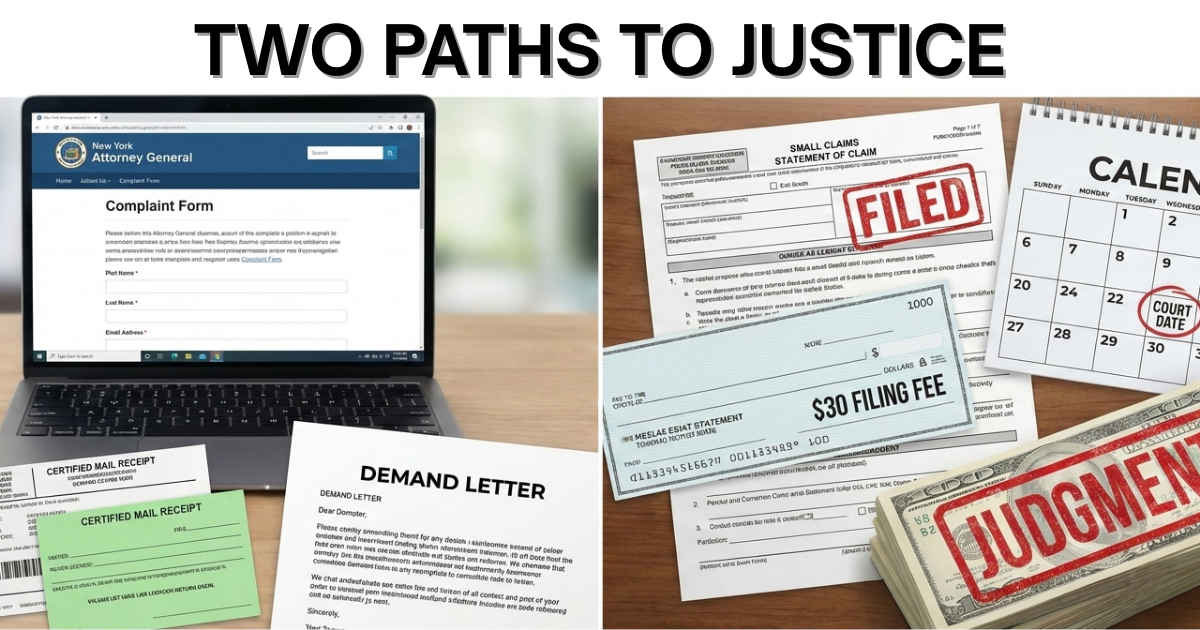
When your landlord refuses to return your security deposit despite your requests, you need to understand New York's enforcement system: there is no "tenant board" with adjudication power, but you have two powerful paths—filing with the Attorney General for investigation and pressure, and suing in Small Claims Court for a binding judgment that forces payment.
Most tenants think these processes are complicated, expensive, or require attorneys. The reality is simpler: Small Claims Court is specifically designed for non-lawyers to handle exactly these disputes, costs under $30 to file, and typically results in winning judgments within 30-60 days when landlords violate the clear 14-day deadline rule.
Understanding New York's Enforcement System
Before diving into how to file, understand what options exist and what each does.
No "Tenant Board" in New York
What tenants often ask for doesn't exist:
Many states have "Landlord-Tenant Boards" or "Rental Housing Tribunals" where disputes are heard. New York doesn't have this.
What New York has instead:
Attorney General enforcement:
- Investigates violations of security deposit law
- Can mediate disputes
- Can pressure landlords to comply
- Cannot issue binding judgment forcing payment
- Free to file complaint
Court system:
- Small Claims Court (up to $10,000 in NYC, $5,000 most cities, $3,000 towns)
- Housing Court (no dollar limit, more formal)
- Issues binding judgments
- Enforceable through marshals/sheriffs
- Costs $15-35 to file
Division of Housing and Community Renewal (DHCR):
- Only handles rent-regulated apartments
- Not security deposits disputes for market-rate units
- Specific jurisdiction over rent stabilization/control issues
The bottom line: For security deposit recovery, you'll use Attorney General complaints for pressure and Small Claims Court for actual money judgments.
Why Two Paths Are Better Than One
Smart strategy uses both simultaneously:
Attorney General complaint:
- Free and easy to file online
- Adds official pressure
- Creates government record of violation
- Landlord takes AG seriously
- May prompt payment to avoid investigation
- Can take weeks to months
Small Claims Court case:
- Costs $15-35 to file
- Requires court appearance
- Results in enforceable judgment
- Typically resolved in 30-60 days
- Landlord knows they'll lose if they violated deadline
- Creates immediate financial consequences
Using both together:
- AG complaint filed same day as demand letter
- Small claims filed 7-10 days after demand letter if no payment
- Landlord faces pressure from two directions
- One or both typically result in payment
- Not mutually exclusive—do both
Step 1: Send Demand Letter First (Required)
Before filing anywhere, you must attempt direct resolution. This isn't just good practice—courts and AG expect it.
Why Demand Letters Matter
Legal and practical reasons:
Courts want to see you tried:
- Judge will ask "did you demand payment?"
- Without demand letter, you look unreasonable
- Weakens your case
AG wants documentation:
- Complaint form asks what you did to resolve
- Demand letter shows good faith effort
- Strengthens AG's leverage with landlord
Many landlords pay at this stage:
- Realize you know the law
- Don't want court hassle
- Avoid AG investigation
- Cheaper to pay than fight
Creates clear record:
- Proves landlord was notified
- Shows exact amount demanded
- Establishes timeline
- Evidence in court if needed
What Your Demand Letter Must Include
Essential elements:
[Your Name]
[Your Current Address]
[Phone]
[Email]
[Date]
[Landlord Name]
[Landlord Address]
RE: FINAL DEMAND FOR RETURN OF SECURITY DEPOSIT
[Old Apartment Address]
Dear [Landlord Name]:
I am writing to demand the immediate return of my security deposit in the amount of $[amount] for the apartment at [address].
FACTS:
- I rented the apartment from [lease start date] to [move-out date]
- I paid a security deposit of $[amount] on [date]
- I vacated the apartment and returned all keys on [move-out date]
- The apartment was left in good condition with only normal wear and tear
LEGAL VIOLATION:
Under New York General Obligations Law § 7-108, you were required to either:
1. Return my full security deposit within 14 days of move-out, OR
2. Provide written, itemized statement of deductions within 14 days
I moved out on [date]. Your deadline was [date—14 days later].
As of today, [current date], you have failed to return any portion of my deposit or provide any itemization. This failure, now [X] days past your legal deadline, results in automatic forfeiture of any right to withhold any amount under New York law.
PRIOR CONTACT:
I have previously contacted you requesting return of my deposit:
- [Date]: [method—text/email/phone]
- [Date]: [method]
- [Date]: [method]
You have not responded to any of these requests.
FINAL DEMAND:
I demand payment of the full $[amount] security deposit within 7 days of this letter, by check or money order sent to my current address above.
NEXT STEPS IF YOU DO NOT PAY:
If I do not receive payment within 7 days, I will immediately:
1. File a complaint with the New York Attorney General's office documenting your violation of GOL § 7-108
2. File a claim in Small Claims Court seeking:
- The full deposit amount of $[amount]
- Punitive damages up to twice the deposit for willful violation
- Court filing fees and costs
New York courts consistently rule in favor of tenants when landlords violate the clear 14-day deadline. Your violation is well-documented and indisputable.
This is your final opportunity to resolve this matter without government and court involvement.
Sincerely,
[Your Signature]
[Your Printed Name]
Enclosures: None [or list if attaching timeline, etc.]
How to Send the Demand Letter
Maximize proof of delivery:
Certified mail, return receipt requested:
- Go to post office
- Fill out certified mail form
- Pay for return receipt (green card)
- Cost: approximately $8-10 total
- Keep postal receipt
- When return receipt comes back, keep it
- Proves landlord received letter
Email same day:
- Send to landlord's email
- Subject: "FINAL DEMAND - Security Deposit"
- Attach PDF of letter
- Creates additional timestamp
- Faster than mail
Text if you have landlord's cell:
- "I sent formal demand letter today via certified mail and email regarding my security deposit. Please confirm receipt."
- Creates third contact point
Keep copies of everything:
- Letter for your records
- Postal receipt
- Return receipt when delivered
- Email sent confirmation
- Text thread
Set calendar reminder:
- Day 8 after sending: prepare to file if no response
- Day 10: file AG complaint and small claims if no payment
What Happens After Demand Letter
Three possible outcomes:
1. Landlord pays (best case):
- Check arrives within days
- Dispute resolved
- No need to file anything
2. Landlord responds with excuses:
- Offers partial payment
- Claims damage existed
- Makes excuses for delay
- You can negotiate or proceed to filing
3. Landlord ignores (most common):
- No response to letter
- No payment
- Time to file AG complaint and small claims
Don't wait longer than 10 days. If no payment by then, landlord is calling your bluff. Time to make good on your promise to file.
Option A: File Complaint with NY Attorney General
This is your free, easy first filing that adds official pressure.
What the Attorney General Can Do
AG's authority over security deposits:
Investigative power:
- Can demand landlord's records
- Can subpoena bank statements
- Can investigate whether separate account exists
- Can check for pattern of violations
Enforcement authority:
- Can negotiate on your behalf
- Can mediate disputes
- Can pressure landlord to comply
- Can impose fines for violations
- Can refer for prosecution if criminal
What AG cannot do:
- Cannot issue binding judgment
- Cannot force landlord to pay you directly
- Cannot garnish landlord's wages
- Cannot seize landlord's assets
Think of AG as pressure tool, not court replacement.
How to File AG Complaint
Go to ag.ny.gov:
Navigate to complaint form:
- Search site for "security deposit" or "tenant rights"
- Look for "File a Complaint" button
- Select consumer protection category
- Choose "housing" or "landlord-tenant" subcategory
Online form includes:
Your information:
- Name
- Current address
- Phone number
- Email address
Landlord information:
- Name (individual or company)
- Address
- Phone if you have it
- Business name if applicable
Property information:
- Rental apartment address
- Lease dates
- Move-out date
Complaint details:
Amount at issue: $[deposit amount]
Description of problem: "Landlord violated NY General Obligations Law § 7-108 by failing to return my security deposit or provide itemized statement within required 14 days. I moved out [date], deadline was [date 14 days later], and landlord has not responded despite multiple requests. I am owed $[amount]."
What you've done to resolve: "Sent formal demand letter on [date] via certified mail requesting return of deposit. Landlord has not responded or returned deposit."
What you're seeking: "Return of full $[amount] security deposit that was illegally withheld past the 14-day deadline."
Documents to Upload
Required attachments:
1. Lease or rental agreement
- Shows you were tenant
- Shows deposit amount
- Shows lease terms
2. Proof of deposit payment
- Receipt from landlord
- Cancelled check
- Bank statement showing payment
- Money order stub
3. Proof of move-out
- Photos with timestamps
- Text/email confirming key return
- Any move-out paperwork
4. Your demand letter
- Copy of letter you sent
- Postal receipt showing you sent it
- Return receipt if you have it
5. Timeline document
- Simple one-page showing:
- Move-out date
- 14-day deadline
- Current date
- Days past deadline
- Your contact attempts
- Landlord's non-response
Save as PDFs, upload to form.
What Happens After You File
AG's process:
Confirmation:
- You'll receive confirmation email
- Complaint number assigned
- Can check status online
Initial review:
- AG staff reviews complaint
- Determines if it falls within their jurisdiction
- Decides whether to investigate
Contact with landlord:
- AG may send letter to landlord
- Requests response and documentation
- Asks for explanation of violation
Possible outcomes:
Landlord pays:
- AG's letter prompts landlord to return deposit
- Landlord doesn't want AG investigation
- You get your money—case closed
Landlord responds with excuses:
- AG reviews response
- May mediate between you and landlord
- Attempts negotiated resolution
AG investigates further:
- If pattern of violations suspected
- Requests bank records
- Checks for systematic abuse
- May result in fines or prosecution
AG closes case:
- If no jurisdiction or no violation found
- You can still pursue small claims
- AG action doesn't prevent court case
Timeline: Weeks to months, typically 4-8 weeks for initial contact with landlord
Why File with AG Even If Also Going to Court
Strategic benefits:
Adds pressure:
- Landlords fear government scrutiny
- Don't want AG investigating their practices
- May pay to make AG go away
Creates official record:
- Documents violation in government database
- Helps future tenants
- Builds case file if landlord is repeat offender
No downside:
- Free to file
- Takes 20 minutes online
- Doesn't prevent small claims case
- Can only help, can't hurt
Helps other tenants:
- If landlord does this routinely
- AG may investigate broader pattern
- May result in enforcement action
- Stops landlord from victimizing others
File AG complaint same day or day after sending demand letter. Don't wait to see if demand letter works.
Option B: Sue in Small Claims Court
This is how you get a binding judgment that forces payment.
Understanding Small Claims Court
What Small Claims Court is:
Designed for non-lawyers:
- Simple procedures
- No attorney needed
- Judge doesn't expect legal expertise
- Clerks help with forms (but can't give legal advice)
Fast process:
- File to hearing: typically 3-6 weeks
- One hearing usually decides case
- Judgment same day in many cases
Low cost:
- Filing fee: $15-35 depending on amount and court
- Service costs: usually court handles
- No attorney fees to pay
Informal:
- No formal rules of evidence
- Judge asks questions
- Both sides tell their story
- Judge decides based on fairness and law
Dollar limits:
- NYC (all boroughs): $10,000 maximum
- Most other NY cities: $5,000 maximum
- Towns and villages: $3,000 maximum
Perfect for security deposits: Most deposits are $1,500-$5,000—well within limits.
Where to File Your Case
Location matters—file in right court:
General rule: File in county where rental property is located
New York City (5 boroughs):
- Bronx: Bronx Civil Court, Small Claims Part
- Brooklyn (Kings County): Kings County Civil Court, Small Claims Part
- Manhattan (New York County): New York County Civil Court, Small Claims Part
- Queens: Queens Civil Court, Small Claims Part
- Staten Island (Richmond County): Richmond County Civil Court, Small Claims Part
Outside NYC:
Cities and larger towns:
- City Court or District Court Small Claims Part
- Examples: Buffalo City Court, Rochester City Court, Yonkers City Court
Smaller towns and villages:
- Town or Village Justice Court
- Often called "Justice Court"
- Small Claims Part
Find your specific court:
- Visit nycourts.gov
- Click "Find a Court"
- Enter your county
- Look for "Small Claims" information
- Note address, hours, phone number
Alternative venue: In some cases, can file where landlord's business is located, but safest is where property is.
How to Start Your Small Claims Case
Step-by-step filing process:
Step 1: Get the form
In person:
- Go to Small Claims clerk's office during business hours
- Ask for "Small Claims Statement of Claim" form
- Also called "Complaint" or "Petition" in some courts
- Clerk will give you form
Online:
- Some courts allow e-filing
- Check court website
- Download fillable PDF
- Complete and submit electronically
Step 2: Fill out the Statement of Claim
Plaintiff information (you):
Name: [Your full legal name]
Address: [Your current address]
Phone: [Your phone number]
Email: [Your email]
Defendant information (landlord):
Name: [Landlord's full name or company name]
Address: [Landlord's address or business address]
If landlord is company: Use company legal name exactly as shown on lease
If landlord is individual: Use their full legal name
Claim details:
Amount claimed: Calculate total:
- Security deposit: $[amount]
- Interest owed (if 6+ unit building): $[amount]
- Punitive damages (if claiming): $[up to double deposit]
- Filing fee: $[amount]
- Total: $[sum]
Example:
- Deposit: $2,400
- Interest (5 years, 6+ units): $120
- Punitive damages: $4,800
- Filing fee: $25
- Total: $7,345
Basis of claim (reason):
Short version for form: "Defendant landlord violated NY General Obligations Law § 7-108 by failing to return $[amount] security deposit within required 14 days after Plaintiff moved out on [date]. Deadline was [date]. Defendant has not returned deposit or provided valid itemization. Plaintiff seeks return of deposit plus punitive damages for willful violation."
Longer version if space allows: "Plaintiff rented apartment at [address] from [start date] to [move-out date]. Plaintiff paid $[amount] security deposit. Plaintiff vacated on [date] and returned all keys. Under NY GOL § 7-108, Defendant had 14 days to return deposit or provide itemized deductions. Deadline was [date]. Defendant failed to comply, now [X] days late. Defendant forfeited all withholding rights. Plaintiff demanded return via certified letter dated [date]. Defendant did not respond. Plaintiff seeks full deposit, interest [if applicable], and punitive damages up to twice deposit for willful violation."
Step 3: File with court
Bring to clerk's office:
- Completed Statement of Claim
- Filing fee (cash or card—check with court)
- Copy of your demand letter
- Photo ID
Clerk will:
- Review form for completeness
- Accept filing and stamp it
- Assign case number
- Set hearing date (usually 3-6 weeks out)
- Explain service requirements
- Give you copies
Pay filing fee:
- NYC: varies by amount claimed, typically $15-35
- Other courts: similar range
- If you cannot afford fee, ask for fee waiver form
Step 4: Service of process
Landlord must be officially notified:
Court usually handles service:
- Many courts serve defendant by mail
- Court mails notice to landlord
- Landlord gets copy of your claim and hearing date
If you must arrange service:
- Some courts require you to serve defendant
- Hire process server (costs $30-75), OR
- Have friend/family over 18 serve (free)
- Cannot serve defendant yourself
- Must prove service with affidavit
Service requirements vary by court—clerk will explain.
Preparing for Your Small Claims Hearing
Between filing and hearing date, get organized:
Documents to bring (3 copies—judge, landlord, you):
Essential documents:
- Your filed Statement of Claim
- The stamped copy clerk gave you
- Shows case number and hearing date
- Lease agreement
- Showing rental terms
- Showing deposit amount
- Showing lease dates
- Proof of deposit payment
- Receipt from landlord
- Cancelled check front and back
- Bank statement showing payment
- Money order receipt
- Move-out evidence
- Photos of apartment on move-out day with timestamps
- Text/email confirming key return
- Any move-out inspection form
- Move-in photos if you have them (shows pre-existing conditions)
- Timeline document (most important)
SECURITY DEPOSIT CASE TIMELINE
Lease signed: [date]
Monthly rent: $[amount]
Security deposit paid: [date] - Amount: $[amount]
Tenancy period: [start date] to [move-out date]
Move-out date: [date]
Keys returned: [date]
LANDLORD'S LEGAL DEADLINE: [date—14 days after move-out]
Days past deadline as of today: [number] days
MY ATTEMPTS TO RECOVER DEPOSIT:
[Date]: Texted landlord requesting deposit - no response
[Date]: Emailed landlord - no response
[Date]: Sent certified demand letter
[Date]: Demand letter delivered (per return receipt)
[Date]: Filed AG complaint
[Date]: Filed this small claims case
LANDLORD'S RESPONSE: None
AMOUNT OWED: $[deposit amount]
INTEREST OWED: $[amount if applicable]
TOTAL CLAIMED: $[total]
- Demand letter
- Copy of letter you sent
- Postal receipt
- Return receipt (green card)
- Email confirmation if sent electronically
- Evidence of landlord's non-response
- Text message screenshots
- Email threads
- Phone logs if you called
- Anything showing you tried and they ignored
- GOL § 7-108 statute
- Print the law
- Highlight relevant portions
- Have available for judge
Optional but helpful:
- Photos showing apartment in good condition at move-out
- Any receipts for cleaning you did
- Expert estimates showing landlord's charges were inflated (if they sent late itemization)
- Proof of separate account violation if applicable
Organize in folder:
- Clearly labeled
- In chronological order
- Easy to reference during hearing
Practice your explanation:
What you'll tell judge (2-3 minutes):
"Your Honor, I'm here to recover my $[amount] security deposit that my landlord illegally withheld. I rented [address] from [date] to [date]. I paid $[amount] deposit. I moved out on [date] and returned the keys. The apartment was in good condition—I have photos. Under New York law, my landlord had 14 days to return my deposit or send me a list of deductions. That deadline was [date]. It's now [current date], [X] days past the deadline. I've texted, emailed, and sent a certified letter demanding my deposit. My landlord has never responded. Under GOL § 7-108, landlords who miss the 14-day deadline forfeit all rights to keep any portion of the deposit. I'm asking for my full $[amount] deposit back, plus [punitive damages if claiming] because this was a willful violation."
Stay calm, factual, organized.
What Happens at the Small Claims Hearing
Day of hearing:
Arrive early:
- 30 minutes before scheduled time
- Find your courtroom (check posted calendars)
- Check in with clerk or court officer
- Have all documents ready
Court atmosphere:
- Informal setting
- Multiple cases heard same day
- Your case may be called any time
- Be patient
When your case is called:
Both parties go before judge:
- You (plaintiff) and landlord (defendant)
- Stand at tables/podium
- Judge introduces case by number and parties
You present first:
- Judge asks you to explain your claim
- Present your timeline and key documents
- Stay focused on the deadline violation
- Show you demanded payment
- Show landlord failed to comply
Key points to make:
- "I moved out [date] and returned keys"
- "Landlord's deadline under law was [date]"
- "Landlord failed to return deposit or itemize within 14 days"
- "That failure forfeits all withholding rights under GOL § 7-108"
- "I demanded payment in writing—landlord ignored me"
- "I'm entitled to full deposit plus [punitive damages] for willful violation"
Landlord presents:
- Landlord explains their side
- May claim damage existed
- May make excuses for missing deadline
- May argue penalties aren't warranted
Common landlord defenses (and your responses):
"There was real damage"
- Your response: "Even if true, landlord missed the legal deadline to document it. Forfeiture is the penalty for procedural violation."
"I didn't know about 14-day rule"
- Your response: "Landlords are professionals expected to know the law. Ignorance is not a defense."
"I sent something but tenant didn't get it"
- Your response: "Landlord has burden to prove they sent it. No certified mail receipt = didn't prove compliance."
"Tenant left early so I had more time"
- Your response: "Fourteen days starts from actual move-out, not lease end. Law is clear."
Judge asks questions:
- Judge may ask both of you questions
- Answer honestly and directly
- Refer to your timeline
- Stay respectful
Judge decides:
Three possible outcomes:
You win full amount:
- Judge finds landlord violated deadline
- Orders return of full deposit
- May award punitive damages
- May award court costs
You win partial amount:
- Rare when deadline clearly violated
- Would require judge finding some technical issue
Landlord wins:
- Very unlikely if you have clear timeline evidence
- Could happen if landlord proves timely compliance (rarely can)
Most common outcome: You win.
Judges see these cases constantly, know the law, and rule strictly on deadline violations.
Judgment details:
- Judge announces decision
- Written judgment issued
- Landlord typically has 30 days to pay
- Judgment entered into court records
After You Win: Collecting Your Judgment
If landlord pays voluntarily:
If landlord doesn't pay: You can enforce judgment through court mechanisms.
Enforcement options:
1. Information subpoena:
- Court order requiring landlord to disclose assets
- Bank accounts, property, income sources
- Helps you find money to collect
2. Wage garnishment:
- Court orders landlord's employer to withhold wages
- Pays you directly
- Continues until judgment satisfied
3. Bank account levy:
- Marshal/sheriff can freeze and seize funds from landlord's bank account
- Requires knowing which bank
- Very effective if landlord has funds
4. Property lien:
- Judgment becomes lien on landlord's property
- Must be paid when property sold or refinanced
- Long-term collection tool
5. Marshal/sheriff seizure:
- Can seize landlord's personal property
- Sell at auction to satisfy judgment
- Last resort
How to start enforcement:
Return to court:
- Bring your judgment
- Ask clerk for enforcement forms
- File appropriate motion
- Pay small fee (usually $5-15)
Marshal/sheriff involvement:
- Court will assign marshal (NYC) or sheriff (elsewhere)
- They execute collection
- They get percentage of collection as fee
- Costs come from landlord, not you
Most landlords pay once enforcement starts:
- Don't want wages garnished
- Don't want bank accounts frozen
- Cheaper to pay than fight
Judgment is good for 20 years in New York and accrues 9% annual interest, so you have time to collect.
Strategic Timing: How to Use Both Paths
Optimal timeline for maximum pressure:
Day 1 - Send demand letter:
- Certified mail to landlord
- Email same day
- Starts official clock
Day 2 - File AG complaint:
- Don't wait to see if demand works
- Get AG process started
- Free and takes 20 minutes
Day 8 - Follow up:
- Check if landlord responded to demand
- Check if check arrived
- If nothing, prepare small claims filing
Day 10 - File small claims:
- If still no payment
- Don't wait longer
- Get court process started
Week 2 - AG contacts landlord:
- AG likely sends letter to landlord this week
- Landlord now has two problems: AG investigation AND court case
Weeks 3-6 - Small claims hearing:
- Court date arrives
- Either landlord paid already (from pressure), or
- You go to hearing and win judgment
This timeline creates mounting pressure:
- Demand letter shows you're serious
- AG complaint shows government involvement
- Small claims shows financial consequences imminent
- Landlord realizes situation is escalating
- Most pay rather than face judgment
Special Considerations
You're Outside NYC
Small claims still available statewide:
Different courts handle small claims:
- City courts in larger cities
- District courts in some areas
- Town/village justice courts in rural areas
Dollar limits vary:
- Most cities: $5,000 maximum
- Towns/villages: $3,000 maximum
If deposit exceeds limit:
- Can sue for limit amount only, OR
- File in regular court (more complex), OR
- Accept partial amount to stay in small claims
Find your local court: nycourts.gov has complete directory by county
Landlord Is in Another State
Can still sue where property is:
- File in county where rental was located
- New York court has jurisdiction
- Landlord must appear or loses by default
Service may be more complicated:
- May need to hire process server
- May require mailing to out-of-state address
- Court clerk can explain requirements
You Moved Out of State
Can still sue from anywhere:
- File in NY county where rental was
- Give your current out-of-state address
- May need to return for hearing, OR
- Some courts allow phone/video appearance
Check with court about remote options: Many courts now allow remote hearings post-COVID
Landlord Is Company, Not Individual
Sue the company:
- Use company's legal name from lease
- File at company's business address
- Company will send representative or attorney
Judgment against company can be collected from company assets.
Multiple Roommates
Each roommate has claim for their share:
- Can sue together as co-plaintiffs
- Each list their portion of deposit
- Or one roommate sues for all and distributes
All roommates should participate: Stronger case when all tenants confirm facts
You Caused Some Damage
Doesn't eliminate your rights:
- Landlord still had to itemize within 14 days
- If they missed deadline, they forfeited right to deduct
- Even if damage was real
Procedure matters as much as substance.
Judge may ask if apartment had damage—be honest. But emphasize landlord's procedural violation.
Why Small Claims Court Works for Tenants
System designed for exactly this:
Judges know the law:
- See deposit cases daily
- Familiar with GOL § 7-108
- Know landlord tactics
- Generally tenant-friendly on clear violations
Low burden of proof:
- Preponderance of evidence (more likely than not)
- Your timeline document often wins the case
- Landlord must prove they complied (they can't if they missed deadline)
No legal expertise needed:
- Tell your story clearly
- Show your evidence
- Let judge apply the law
Fast and cheap:
- Under $30 to file
- 4-8 weeks total
- One appearance
- Done
Enforceable judgment:
- Not just advisory
- Backed by court authority
- Collectible through marshals
- Follows landlord for 20 years
High win rate for tenants on deadline violations: When you have clear evidence landlord missed 14-day deadline, you almost always win.
The Process Is Simpler Than You Think
Filing to recover your illegally withheld security deposit involves two straightforward steps that don't require legal knowledge, don't cost more than $30, and typically result in you getting your money back within weeks.
The process:
- Send demand letter citing the 14-day violation
- File AG complaint online (free, 20 minutes)
- File small claims court case (under $30, one form)
- Gather your evidence (timeline + documents)
- Appear at hearing (30-60 days later)
- Win judgment (same day usually)
- Collect your money
What stops most tenants isn't complexity—it's not knowing these paths exist and believing the process is harder than it is.
The law is on your side. The violation is clear. The process is designed for non-lawyers. The judges rule consistently for tenants on deadline violations. You just need to follow through.
Send that demand letter today. File that AG complaint tomorrow. File small claims next week. Show up to court with your timeline. Get your money back.
Find out if you have a case in 30 seconds →