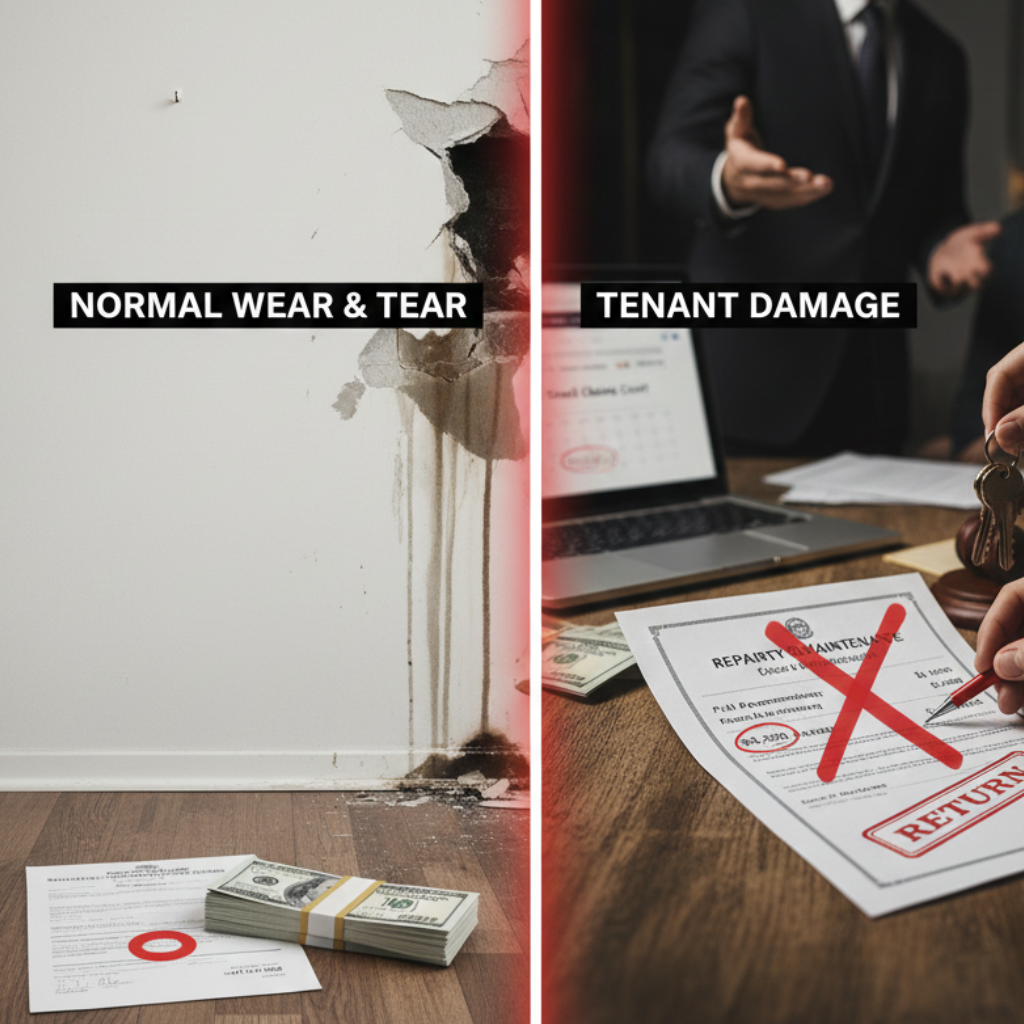
Your landlord can hold part of your security deposit for repairs—but only for damage you actually caused that exceeds normal wear and tear. When landlords claim your apartment "needs repairs," they're often confusing (or deliberately conflating) damage you're responsible for with deterioration they're required to fix themselves.
Knowing the difference between legitimate repair deductions and landlord overreach is what separates tenants who lose hundreds of dollars from those who get their full deposit back.
The word "repairs" gets thrown around loosely by landlords, but New York law draws a clear line: you're only responsible for damage beyond normal wear and tear that you caused during your tenancy.
Legitimate repair deductions:
Not legitimate (these are normal wear and tear):
The distinction matters because landlords frequently try to pass off their maintenance obligations as your damage.
When your landlord sends an itemized statement claiming repair deductions, your first step is analyzing whether each charge meets legal standards. Most don't survive scrutiny.
Red flags that deductions are improper:
Request receipts and documentation for every deduction. Your landlord must prove actual costs—not just assert them. When they can't produce receipts, those deductions often disappear.
Once you've identified questionable deductions, send a formal demand letter disputing them. This creates your legal record and forces your landlord to either provide proof or back down.
Your demand letter must include:
Key evidence to reference:
Send via certified mail with return receipt. When your landlord signs for this letter and sees documented proof that their charges don't hold up, many immediately offer to return disputed amounts rather than face court.
Timing matters: Send your dispute within 30 days of receiving the itemized statement. While not a strict legal deadline, acting promptly strengthens your case by showing you immediately contested improper charges.
Before or alongside court action, file a complaint with the New York Attorney General's office using their Rent Security Complaint Form. This creates an official government record and may trigger mediation.
What the AG complaint accomplishes:
While the AG won't directly recover your money, landlords facing official complaints often settle quickly to avoid escalated scrutiny of their business practices.
When your demand letter and AG complaint don't resolve the dispute, small claims court becomes your most powerful tool. The process is straightforward, requires no lawyer, and judges consistently rule for tenants when deductions are clearly improper.
Small claims limits in New York:
What you can recover:
What to bring to court:
Judges see landlords trying to charge for normal wear and tear constantly. When you present photos proving the apartment's condition and documentation showing charges are unreasonable, you're not arguing—you're proving a clear violation.
New York courts award punitive damages when landlords act in bad faith—meaning they knew their deductions were improper but withheld money anyway.
Evidence of bad faith includes:
A landlord who withheld $1,500 for "repairs" that were actually normal wear could face a $3,000 judgment. This risk makes most landlords reconsider their position once they receive a well-documented dispute.
The strength of your case depends entirely on documentation proving your apartment's actual condition versus what your landlord claims.
Critical evidence to gather:
Photos and videos:
Written documentation:
Financial records:
Witness statements:
This documentation doesn't just support your case—it often ends the dispute entirely when landlords realize you have proof their charges won't survive court scrutiny.
When your landlord claims repairs cost $800, get your own estimates showing the same work costs $200. This gap between claimed costs and actual market rates proves overcharging and strengthens bad faith arguments.
How to get useful estimates:
Contractors providing estimates don't need to see the apartment—they're estimating standard repair costs, which is all you need to demonstrate your landlord's charges are inflated.
When a contractor says painting one room shouldn't exceed $300 and your landlord charged $900, judges immediately see the problem.
If your apartment is rent-stabilized or rent-controlled, contact the Division of Housing and Community Renewal (DHCR) in addition to pursuing your deposit dispute. These units have additional protections and DHCR has enforcement powers beyond standard security deposit law.
DHCR can:
File a complaint with DHCR even if you're also pursuing small claims court—the processes run parallel and increase pressure on landlords to settle.
Understanding why landlords improperly withhold deposits helps you counter their tactics and strengthen your dispute.
Common landlord motivations:
None of these reasons make deductions legal. Your landlord's financial situation or motivation is irrelevant—only whether charges meet legal standards matters.
Acting quickly strengthens your case by showing you immediately contested improper charges and didn't accept them as valid.
Recommended timeline:
This timeline keeps pressure on your landlord while giving them opportunities to settle before court. Most disputes resolve during the demand letter phase when landlords see documented proof their charges won't hold up.
Landlords count on tenants accepting improper deductions without challenge. When you don't dispute within a reasonable time, courts may view this as acceptance of the charges.
Consequences of not acting:
Disputing promptly protects your rights and increases your likelihood of full recovery.
While most landlord repair claims are overreaching, some situations do justify deductions. Understanding when you're actually liable prevents wasting time disputing valid charges.
You are responsible for:
Even when damage is your fault, deductions must be reasonable and documented with actual costs. Your landlord can't charge $500 for a repair that costs $150.
Many landlords treat security deposits as renovation funds for refreshing apartments between tenants. This is illegal—they're responsible for maintaining their property, and your deposit only covers damage you caused.
What landlords must pay for themselves:
When your landlord's "repair" list reads like a property improvement project rather than fixing specific damage you caused, you're looking at clear violations worth disputing.
Tenants often wonder if disputing a $300 deduction is worth the effort. The math actually favors you significantly.
What you're really recovering:
Even a $300 dispute that results in $600 recovery plus fees means you earned $100+ per hour for your time. Most resolve before court, requiring even less time investment.
When your landlord sent an itemized statement with improper repair charges, they started a process where New York law heavily favors you. Every requirement they fail to meet—missing receipts, unreasonable charges, inflated costs—strengthens your position.
You're not being difficult by disputing improper charges. You're enforcing the law and ensuring your landlord can't fund their property maintenance with your money.
Document the apartment's condition. Challenge charges that don't meet legal standards. Send your demand letter. File in small claims if needed. The process is straightforward, the law is clear, and judges consistently rule for tenants when landlords try to charge for repairs that are actually their responsibility.