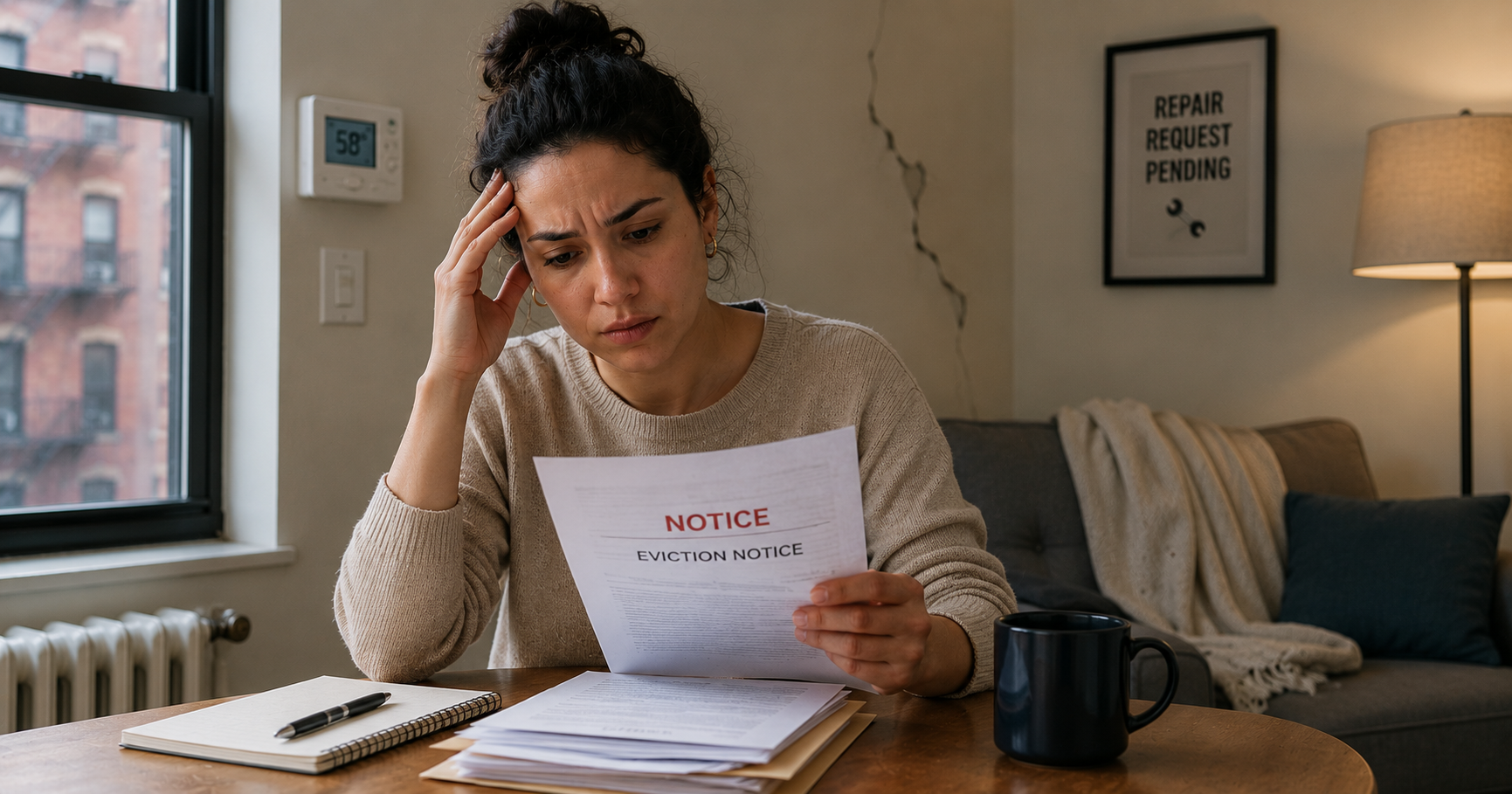
You're living with serious problems in your apartment—no heat, dangerous mold, pest infestations, broken locks, or other habitability violations—but you're terrified to report them or assert your rights because you're convinced that the moment you speak up, your landlord will retaliate by evicting you or refusing to renew your lease. Maybe you've already started to complain, and your landlord responded with thinly veiled threats: "You know, tenants who cause problems usually don't get their leases renewed," or "I can always find someone who appreciates this apartment more," or "Keep calling 311 and we'll see what happens." The message is clear—stay quiet or lose your home.
This fear feels absolutely rational. You know how hard it was to find this apartment—the competitive application process, the high deposit, the months of searching. You remember how few options you had in your price range, how many applications were rejected, how fortunate you felt just to get this place even with its problems. The thought of starting that process over, of being homeless even temporarily, of your children having to change schools, of not being able to find anything you can afford—these possibilities are terrifying enough that you decide it's safer to live with the mold, the roaches, the broken heat, the harassment, rather than risk displacement.
You watch your landlord violate your rights daily—entering without notice, refusing to make repairs, harassing you about minor issues—and you say nothing. When friends suggest you call 311 or contact a tenant attorney, you explain that they don't understand how precarious your housing situation is, that you can't afford to rock the boat, that speaking up is a luxury you don't have. You absorb the harassment, the uninhabitable conditions, the lease violations, telling yourself it's the price of keeping a roof over your head.
Here's the truth: Your fear that asserting your rights will lead to eviction is precisely the fear landlords cultivate to prevent you from exercising those rights—but New York law includes powerful anti-retaliation protections specifically designed to prevent landlords from evicting or punishing tenants who complain about housing violations, call 311, request repairs, or assert any tenant rights. Not only is retaliatory eviction explicitly illegal under New York law, but the legal framework creates presumptions in your favor when landlords try to evict or non-renew after you've asserted rights, shifting the burden to landlords to prove their actions weren't retaliatory. Courts and housing agencies are specifically trained to identify and punish landlord retaliation, and tenants who are wrongfully evicted or threatened for asserting rights have legal remedies including staying in their apartments, recovering damages, and holding landlords accountable.
Let me show you exactly what New York's anti-retaliation laws actually say and how they protect you, why the timing of landlord action after your complaints creates legal presumptions in your favor, what "eviction" actually requires legally and why landlords can't just throw you out for complaining, how courts handle retaliatory eviction attempts and why landlords often lose these cases, what to do if your landlord threatens or attempts retaliation, and why speaking up actually makes you safer in your housing than staying silent.
Understanding the specific legal protections you have against retaliation helps you see that your rights aren't as fragile as you fear.
New York Real Property Law § 223-b is the state's primary anti-retaliation protection, and it's more powerful than most tenants realize.
The statute explicitly prohibits landlords from retaliating against tenants who have, in good faith, complained to landlord or governmental authority about conditions affecting health or safety, complained to governmental authority about violations of health, safety, or building codes, or participated in tenant organizations or sought legal assistance regarding tenancy rights.
Protected activities triggering anti-retaliation protection include making repair requests to your landlord for habitability violations, calling 311 or contacting HPD about housing code violations, filing complaints with health departments or code enforcement, reporting to any governmental authority about unsafe or illegal conditions, participating in tenant associations or organizing with other tenants, seeking legal help from Legal Aid, tenant attorneys, or advocacy organizations, filing HP proceedings or other court actions to enforce your rights, and essentially any good-faith assertion of your rights as a tenant under housing law.
Prohibited retaliatory actions that landlords cannot take against you for engaging in protected activities include attempting to evict you or actually evicting you, substantially decreasing services to you (cutting off heat, hot water, or other services), substantially increasing your rent beyond normal increases, and taking any adverse action against your tenancy in response to your protected activity.
The breadth of protection is important—you're protected not just for calling 311, but for any good-faith assertion of tenant rights. Asking for repairs, joining a tenant association, talking to a lawyer, filing court cases—all of these trigger anti-retaliation protection.
The anti-retaliation statute includes a critical provision that dramatically shifts the legal burden in your favor.
Under RPL § 223-b, if landlord takes retaliatory action (eviction, non-renewal, service reduction, substantial rent increase) within six months after you engaged in protected activity, the law presumes the landlord's action was retaliatory. This presumption means that you don't have to prove the landlord was retaliating—the law automatically assumes retaliation based on the timing alone.
The burden then shifts to the landlord to prove their action was NOT retaliatory and would have occurred regardless of your protected activity. This is a difficult burden for landlords to meet. They must show they had legitimate, non-retaliatory reasons for the eviction, non-renewal, or other action, and that they would have taken the same action even if you hadn't complained.
Practical example: You call 311 about no heat in January. In March (two months later, well within six-month window), landlord serves you with eviction papers claiming you violated your lease by having unauthorized occupant. The law presumes this eviction attempt is retaliation for your 311 call. The landlord must now prove the eviction is legitimately about the alleged lease violation and not retaliation for your complaint—a very difficult burden when timing clearly connects your complaint to their eviction attempt.
This presumption is extraordinarily powerful protection. It means that for six months after you assert your rights, landlord actions against you are viewed with extreme suspicion by courts and are presumed illegal until landlord proves otherwise. This flips the usual burden of proof and makes retaliation very legally risky for landlords.
Six months is a long time. Most leases renew annually, so six-month presumption often covers you until well past your next lease renewal period. And the presumption applies to non-renewals too—if landlord refuses to renew your lease within six months of your complaint, that's presumed retaliation.
The anti-retaliation law protects complaints made "in good faith," and this standard is much easier to meet than you might fear.
Good faith simply means you genuinely believe there's a problem and you're reporting it honestly. You don't have to be right about every detail, you don't have to prove violations to a legal certainty before reporting, and you're allowed to be wrong about some aspects of your complaint as long as you're not intentionally making false reports.
Courts interpret good faith broadly to protect tenants. If you honestly believe your apartment has habitability violations and you report them, you're acting in good faith even if inspectors later determine some issues aren't code violations or aren't as severe as you thought.
What's NOT good faith is knowingly making false reports to harass landlord or gain advantage—fabricating violations you know don't exist, making false allegations of discrimination or harassment you know are untrue. But honest mistakes, different interpretations of lease terms, or genuine disagreements about severity of conditions don't destroy good faith.
Your complaints about actual problems you're experiencing (no heat, mold, pests, leaks, harassment, improper charges) are almost certainly good faith complaints that trigger anti-retaliation protection, even if landlord disputes that problems exist or claims you're exaggerating.
New York City provides even stronger protections beyond state anti-retaliation law.
NYC harassment provisions explicitly prohibit landlords from taking any action intended to cause tenants to vacate or surrender rights, including threats of eviction, baseless eviction attempts, refusal to renew leases as retaliation, and creation of hostile environment to pressure tenants out.
HPD actively enforces against harassment and retaliation. When you report landlord retaliation to 311, HPD can issue harassment violations, impose civil penalties, and create official records supporting your retaliation defense.
The combination of state anti-retaliation law, NYC harassment provisions, and active HPD enforcement creates multilayered protection against landlord retaliation in New York City.
Your fear of being "evicted" for speaking up is based partly on misunderstanding what eviction actually requires legally and how difficult it is for landlords to accomplish.
Perhaps the most important thing to understand is that landlords cannot unilaterally evict tenants. They cannot throw you out, change locks, or force you to leave without going through formal legal process in court.
Legal eviction requires:
This process takes weeks to months even when landlord has legitimate grounds for eviction. When landlord is attempting retaliatory eviction, the process creates multiple opportunities for you to raise retaliation as defense and for courts to identify and stop the illegal eviction attempt.
Self-help eviction is illegal. Landlords who change locks, shut off utilities, remove your belongings, or physically force you out without court process are committing illegal lockout, subject to criminal penalties and civil damages including treble (triple) damages. You can call police for illegal lockout and sue for substantial damages.
Your protection is that eviction must go through courts, and courts are specifically trained to identify retaliatory eviction and have power to dismiss cases, sanction landlords, and protect you from illegal retaliation.
Landlords cannot evict you simply because they want to—they need legal grounds and must prove them in court.
Legal grounds for eviction include non-payment of rent (you stopped paying and owe rent), lease violations (you violated material terms of lease), illegal activity in the apartment, holdover after lease term ended, or owner use/demolition (in limited circumstances with proper notice).
To evict you, landlord must prove grounds exist. They can't just allege lease violation—they must present evidence convincing a judge that you actually violated the lease in a material way warranting eviction.
Minor or technical violations generally don't support eviction. Courts require violations be substantial and material. Missing a rent payment by a few days, having overnight guest occasionally, minor noise complaints—these don't support eviction absent aggravating factors or patterns.
When retaliation is at play, courts scrutinize landlord's claimed grounds extremely carefully. If landlord ignored your occasional overnight guests for two years but suddenly claims it's lease violation immediately after you called 311, court will likely conclude the claimed violation is pretextual and the real reason is retaliation.
When landlord attempts eviction after you've asserted your rights, you have powerful defense.
Retaliation as affirmative defense means you admit the facts landlord alleges (maybe you did have overnight guest, maybe rent was three days late) but argue landlord's reason for evicting you for this is retaliation for your protected activity, not genuine concern about the alleged violation.
You present evidence of the timeline: "I called 311 about no heat on January 15. I received this eviction notice on February 3, claiming I violated lease by having overnight guest—something landlord never complained about in my two years of tenancy. The timing and selective enforcement prove this is retaliation for my 311 complaint, not legitimate lease enforcement."
Courts regularly dismiss eviction cases when retaliation is proven. Judges have discretion to refuse to grant eviction when landlord's motive is retaliatory, even if tenant technically violated some lease provision. The principle is that landlords cannot use legal process to punish tenants for asserting rights.
If you win retaliation defense, the eviction case is dismissed, you stay in your apartment, you may be awarded attorney fees, and landlord's retaliatory attempt is documented creating strong evidence if they try again.
Understanding how these cases typically play out helps you see why landlords often lose and tenants often prevail.
Housing Court judges and court personnel see retaliatory eviction attempts constantly and are specifically trained to identify and reject them.
Judges look for red flags including timing (eviction shortly after complaint), selective enforcement (enforcing lease provision never enforced before), pretextual grounds (claimed violation seems like excuse), escalation (landlord who was previously friendly becomes hostile after complaint), and inconsistency (landlord's explanation doesn't match the pattern).
When these red flags are present, judges often question landlord aggressively about timing and motives, demand landlord explain why lease provision suddenly matters now, scrutinize whether grounds for eviction are legitimate or fabricated, and frequently conclude eviction attempt is retaliatory.
Judges have significant discretion to deny eviction even if technical lease violation exists when they determine landlord's motive is retaliatory rather than legitimate business concern.
The judicial skepticism toward evictions following tenant complaints is real and substantial. Courts are protective of tenant rights to report violations and assert rights without fear of losing housing.
Certain patterns of retaliatory eviction are so common and transparent that they almost always fail in court.
The "sudden lease violation" pattern: Tenant lives in apartment for months or years without issue. Tenant calls 311 or requests repairs. Within weeks, landlord suddenly "discovers" lease violations (unauthorized occupant, pet violation, noise complaints) that allegedly existed all along but landlord never mentioned until after tenant complained. Courts see through this immediately—if violation existed for months and landlord didn't care until after tenant asserted rights, it's retaliation not legitimate enforcement.
The "technical non-renewal" pattern: Landlord doesn't technically evict tenant but refuses to renew lease after tenant complained. In rent-regulated housing, this can violate renewal rights. In market-rate housing, it still triggers anti-retaliation law if within six months of protected activity. Courts can order lease renewal or find landlord liable for improper non-renewal.
The "trumped-up rent claim" pattern: Tenant pays rent properly for years. Tenant complains about conditions. Landlord suddenly claims tenant owes additional rent (late fees tenant never owed before, improper charges, disputes about rent amount) and files eviction for non-payment. Courts scrutinize whether rent claim is legitimate or manufactured to create eviction pretext.
The "nuisance" claim pattern: After tenant complains, landlord claims tenant is creating nuisance through noise, behavior, or other issues—often based on questionable or exaggerated complaints from other tenants or landlord's own characterization. Courts view these skeptically when timing follows protected activity.
These patterns are so well-known that bringing these types of eviction cases after tenant complaints often backfires, resulting in dismissal, sanctions against landlord, and strengthening tenant's position.
Landlords who attempt retaliatory eviction don't just risk losing—they risk serious legal and financial consequences.
Dismissal of eviction case is the minimum consequence. Landlord wastes time and money filing case only to have it thrown out.
Attorney fee awards: Courts can order landlord to pay tenant's attorney fees for defending retaliatory eviction, potentially thousands of dollars.
Damages: Tenants can sue for damages from retaliatory eviction attempts including emotional distress, costs incurred defending eviction, and in some cases punitive damages.
Harassment violations from HPD if eviction attempt was part of harassment campaign, resulting in civil penalties.
Bad landlord reputation: Housing Court records are public, and landlords who repeatedly attempt retaliatory evictions develop reputations that can attract increased scrutiny from housing agencies and courts.
Rent stabilized apartments: For rent-stabilized units, retaliatory eviction attempts can result in permanently destabilizing the rent or other severe sanctions.
These risks make sophisticated landlords hesitant to attempt obvious retaliation. The landlords who threaten eviction for complaints are often either bluffing (making threats they won't follow through on) or unsophisticated (don't understand the law and will lose if they try).
If your landlord threatens eviction or other retaliation after you assert your rights, specific steps protect you.
Creating comprehensive record of retaliation is critical.
Timeline documentation showing protected activity (when you called 311, requested repairs, joined tenant organization), landlord's knowledge of your activity (you told them, they received HPD notice, 311 notified them), and landlord's retaliatory action (when they threatened eviction, served papers, refused renewal, cut off services).
The closer the timing, the stronger your retaliation case. Complaint on Monday, eviction threat on Wednesday is slam-dunk retaliation evidence.
Save all communications where landlord made threats or showed hostility after your complaint. Landlord's own words threatening eviction "if you keep calling 311" or saying "tenants who complain don't get renewed" are admissions of retaliatory intent.
Evidence of selective enforcement: If landlord claims you're being evicted for lease violation, gather evidence that same violation was tolerated before your complaint or is tolerated for other tenants who haven't complained, proving enforcement is selective and retaliatory.
This documentation becomes exhibits in court proving retaliatory motive and timeline.
Don't wait for actual eviction—report threats and retaliation immediately.
Call 311 (NYC) and report landlord harassment and retaliation. Explain you asserted your rights by calling 311/requesting repairs/joining tenant organization, and landlord responded by threatening eviction or taking retaliatory action.
HPD will investigate and can issue harassment violations even for threats of eviction, creating official record of landlord's retaliatory conduct before eviction case is even filed.
This official documentation strengthens your defense if eviction case is later filed—you have HPD records documenting the retaliation timeline before landlord's eviction attempt.
Outside NYC, report to local code enforcement, housing agencies, or tenant protection offices explaining retaliation pattern.
The moment landlord threatens or attempts retaliation, legal representation becomes critical.
Contact Legal Aid, Legal Services NYC, or tenant attorneys immediately. Explain you asserted tenant rights and landlord is retaliating.
Attorneys can:
Legal representation often stops retaliation before it goes further. Landlord receiving letter from Legal Aid stating "we're aware of your retaliatory threats against our client and will vigorously defend any eviction attempt" frequently backs down.
Free legal services are available specifically for these situations—you don't need to be able to afford attorney to get help defending against retaliation.
Perhaps most importantly, don't let retaliation threats silence you or stop you from asserting rights.
If conditions remain uninhabitable, continue reporting violations and demanding repairs even after retaliation threats. The anti-retaliation law protects you specifically so landlords can't use threats to prevent you from enforcing habitability.
Each additional retaliatory action landlord takes further strengthens your case. If they threaten eviction and you back down and stop complaining, they've successfully used illegal intimidation. If they threaten eviction and you continue asserting rights and they follow through with eviction attempt, they've now committed multiple acts of retaliation with clear documentary evidence.
Silence rewards retaliation. Landlords use retaliation threats because they work—many tenants become too afraid to assert rights. But landlords who actually follow through on retaliation threats usually lose in court and face consequences.
Speaking up is legally protected activity. Every time you report violations or assert rights after landlord threatens you, you're creating more evidence of their retaliatory campaign.
Counterintuitively, asserting your rights and documenting problems often provides more housing security than staying silent.
Your fear is that speaking up will trigger eviction, but consider: landlords who want you gone can attempt eviction regardless of whether you complain.
Landlords wanting to evict for market-rate rent increases, to move in family members, or for other reasons don't need you to complain first. If landlord wants you out, they'll either manufacture lease violations, wait for your lease to end and not renew, or find other means.
Your silence doesn't protect you from landlord who wants you gone—it just means you won't have anti-retaliation protections when they move against you.
But if you've asserted rights, and landlord then tries to evict you, you have six-month presumption of retaliation and strong defenses. You're legally better positioned having asserted rights than staying silent.
The calculation isn't "speak up and get evicted vs. stay silent and stay housed." It's "speak up and have strong legal protections if landlord tries anything vs. stay silent and have weaker position if landlord acts against you anyway."
Documentation of habitability violations and landlord failures creates protective evidence.
HPD violations, 311 reports, and official complaints create public record that your apartment has serious problems and landlord has failed to address them.
This paper trail supports constructive eviction claims if you need to leave, habitability defenses if landlord tries to evict you for non-payment, and evidence of landlord's bad faith in any legal proceeding.
Without documentation, if landlord tries to evict you or problems force you to leave, it's your word against theirs about conditions. With official violations and reports, you have government-issued evidence of problems.
The protection of official documentation outweighs the risk of retaliation, especially given anti-retaliation law.
Asserting your rights connects you to resources that strengthen your position.
Once you've called 311, filed complaints, or asserted rights, you can access Legal Aid, tenant advocacy organizations, and free legal services who help tenants facing retaliation.
These resources provide representation in eviction defense, help with HP proceedings to compel repairs, assistance with rent reduction claims, and support in harassment cases.
Tenants who stay silent often lack these connections and face problems alone. Tenants who assert rights become connected to support systems.
The legal aid community is specifically prepared to defend tenants facing retaliation—this is core mission of tenant legal services. You're not alone once you speak up.
Standing up to retaliation attempts establishes you as tenant who knows rights and won't be easily intimidated.
Landlords often target tenants they perceive as vulnerable, uninformed about rights, or unlikely to fight back. Tenants who immediately assert rights, document violations, and show willingness to go to court are less attractive targets for harassment.
When you respond to retaliation threats with "I know my rights, I've documented your retaliation, I've reported to HPD, and I have legal representation," landlords often back down recognizing you're not easy mark.
The strength you demonstrate by asserting rights despite threats can actually deter further landlord misconduct.
Consider what staying silent actually means for your life and health.
Living indefinitely with no heat, dangerous mold, pest infestations, or other serious habitability violations destroys your health, safety, and quality of life.
The fear keeping you silent is fear of losing your home—but what you're protecting by staying silent isn't really a "home" if it's uninhabitable, if you're constantly anxious about your landlord, if your health is suffering from the conditions.
At some point, the conditions may force you to leave anyway—health crisis, conditions becoming truly unlivable, or you just can't take it anymore. Better to assert rights while still there, creating documentation and protections, than to flee in crisis with no legal protections.
The choice isn't between speaking up and staying housed versus staying silent and staying housed. It's between speaking up and having legal protections and support versus staying silent and suffering until you can't bear it anymore.
Your fear that speaking up will cause you to lose your home is the fear landlords want you to have—it's the threat that keeps tenants silent and allows landlords to maintain uninhabitable conditions and violate rights with impunity.
New York's anti-retaliation law (RPL § 223-b) explicitly prohibits landlords from evicting, non-renewing, or punishing tenants for asserting rights. The law presumes retaliation when landlord acts against you within six months of your complaints, shifting burden to landlord to prove otherwise.
Eviction requires court process. Landlords cannot just throw you out. They must file in Housing Court, prove legal grounds, and obtain judgment. You have right to defend, raise retaliation as defense, and courts are trained to identify and dismiss retaliatory eviction attempts.
Common retaliatory patterns fail in court: Sudden enforcement of lease provisions ignored before your complaint. Manufactured lease violations appearing after you assert rights. Pretextual eviction grounds that don't hold up to scrutiny. Judges see these patterns constantly and regularly dismiss cases.
Landlords face serious consequences for retaliation: Eviction case dismissal, attorney fee awards to you, damages liability, HPD harassment violations, public record of bad conduct. These risks deter sophisticated landlords and cause unsophisticated ones to lose.
What to do if landlord threatens retaliation: Document everything—timeline, communications, selective enforcement. Report to 311/HPD immediately. Get legal help from Legal Aid or tenant attorneys. Continue asserting your rights—don't be silenced by threats.
Speaking up actually increases your housing security: Creates official paper trail of violations protecting you. Connects you to legal resources and support. Establishes you as tenant who knows rights. Gives you anti-retaliation protections if landlord acts against you.
The alternative—staying silent—doesn't protect you. Landlords who want you gone will act regardless. But without documentation and anti-retaliation protections from asserting rights, you're more vulnerable not less.
Your rights exist specifically to protect you from this fear. Anti-retaliation law was created because legislators knew landlords would threaten eviction to silence tenants. The law is designed to make speaking up the safer choice.
You have more power than you think. Courts, housing agencies, and legal aid organizations are on your side when landlords retaliate. Assert your rights. Document everything. Get support. Your home is more secure when you stand up for it than when you silently endure abuse.